UNITED STATES
SECURITIES AND EXCHANGE COMMISSION
Washington, D.C. 20549
SCHEDULE 14A
(Rule 14a-101)
Proxy Statement Pursuant to Section 14(a) of
the Securities Exchange Act of 1934
(Amendment No. )
Filed by the Registrant [x]
Filed by a Party other than the Registrant [ ]
Check the appropriate box:
[ ] Preliminary Proxy Statement
[ ] Confidential, for Use of the Commission Only (as permitted by Rule 14a-6(e)(2))
[x] Definitive Proxy Statement
[ ] Definitive Additional Materials
[ ] Soliciting Material Pursuant to §240.14a-11(c) or §240.14a-12
(Name of Registrant as Specified in its Charter)
(Name of Person(s) Filing Proxy Statement, if other than the Registrant)
Payment of Filing Fee (Check the appropriate box):
[x] No fee required.
[ ] Fee paid previously with preliminary materials.
[ ] Fee computed on table below per Exchange Act Rules 14a-6(i)(1) and 0-11.

NOTICE OF 2026 ANNUAL MEETING OF STOCKHOLDERS
 |  |  | ||||||
Date and Time Thursday, November 19, 2026, 11:00 a.m. (CST) | Location Jack Henry & Associates, Inc. HQ 663 Highway 60, P.O. Box 807 Monett, Missouri 65708 | Record Date September 21, 2026 | ||||||
The 2026 Annual Meeting of Stockholders (the “Annual Meeting”) of Jack Henry & Associates, Inc., a Delaware corporation (the “Company”), will be held at the Company’s Headquarters, 663 Highway 60, Monett, Missouri, on Thursday, November 19, 2026, 11:00 a.m., Central Time.
The purpose of the Annual Meeting will be the following:
1.To elect nine directors to serve until the 2027 Annual Meeting of Stockholders;
2.To approve, on an advisory basis, the compensation of our named executive officers;
3.To ratify the selection of the Company’s independent registered public accounting firm; and
4.To transact such other business as may properly come before the Annual Meeting and any adjournments thereof.
The close of business on September 21, 2026, has been fixed as the record date for the Annual Meeting. Only stockholders of record as of that date will be entitled to notice of and to vote at said meeting and any adjournment or postponement thereof.
Notice regarding the availability of proxy materials and this proxy statement and form of proxy are being distributed and made available on or about October 2, 2026. The accompanying form of proxy is solicited by the Board of Directors of the Company. The attached Proxy Statement contains further information with respect to the business to be transacted at the Annual Meeting.
ALL STOCKHOLDERS ARE INVITED TO ATTEND THE MEETING IN PERSON. WHETHER OR NOT YOU EXPECT TO ATTEND, PLEASE DATE AND SIGN THE ENCLOSED PROXY. IF YOU DECIDE TO ATTEND THE MEETING, YOU MAY REVOKE YOUR PROXY AND VOTE YOUR SHARES IN PERSON.
| By Order of the Board of Directors | |||||
 | |||||
| Craig K. Morgan | |||||
| Secretary | |||||
TABLE OF CONTENTS | |||||
Proxy Summary | |||||
Election of Directors (Proposal 1) | |||||
Corporate Governance | |||||
Certain Relationships and Related Transactions | |||||
Delinquent Section 16(a) Reports | |||||
Audit Committee Report | |||||
Executive Officers | |||||
Human Capital & Compensation Committee Report | |||||
Compensation Discussion and Analysis | |||||
Compensation and Risk | |||||
Executive Compensation | |||||
Equity Compensation Plan Information | |||||
| Pay Ratio Disclosure | |||||
| Pay Versus Performance | |||||
Advisory Vote on Executive Compensation (Proposal 2) | |||||
| Ratification of Selection of Independent Registered Public Accounting Firm (Proposal 3) | |||||
Stock Ownership of Certain Beneficial Owners | |||||
Stockholder Proposals and Nominations | |||||
Financial Statements | |||||
Other Matters | |||||
PROXY SUMMARY
This summary highlights certain information for stockholders’ review in connection with the Annual Meeting. This summary does not contain all of the information that stockholders should consider, and stockholders are encouraged to read the entire Proxy Statement carefully before voting.
Business highlights
 | Associates | ~7,300 | Clients | ~7,200 | FY 26 Revenue |  | $2.54B | |||||||||||||||||||||||||||||||||||||
| 22 | Consecutive Calendar Years of Increased Dividends | FY 26 Total Paid Dividends | $170M | NASDAQ: JKHY | ||||||||||||||||||||||||||||||||||||||||
Workplace Awards |  | •US News: Best Companies to Work for 2026-2027 | Formed in 1976 | |||||||||||||||||||||||||||||||||||||||||
•Time: America’s Best Mid-Size Companies 2026 |  | HQ Monett, Missouri | ||||||||||||||||||||||||||||||||||||||||||
Summary of Proposals
2026 Proposals | Board Recommends | See Page | ||||||||||||
| Proposal 1: | Election of Directors. | YES | ||||||||||||
| Proposal 2: | Advisory Vote to Approve the Company’s Named Executive Officer Compensation for Fiscal 2026. | YES | ||||||||||||
| Proposal 3: | Ratification of the Appointment of PricewaterhouseCoopers LLP as the Company’s Independent Registered Public Accounting Firm for Fiscal 2026. | YES | ||||||||||||
 | 2026 Proxy Statement | 1 | |||||||||
Fiscal 2026 Director Nominees
| Name | Title | Director Since | Independent | Committees & Roles | ||||||||||
| Matthew C. Flanigan | Board Chair | 2007 | ü | |||||||||||
| Thomas H. Wilson, Jr. | Director | 2012 | ü | Audit (Chair), Governance | ||||||||||
| Thomas A. Wimsett | Director | 2012 | ü | Audit, Risk and Compliance (Chair) | ||||||||||
| Shruti S. Miyashiro | Director | 2015 | ü | Human Capital & Compensation, Risk and Compliance | ||||||||||
| Curtis A. Campbell | Director | 2021 | ü | Governance (Chair), Human Capital & Compensation | ||||||||||
| Tammy S. LoCascio | Director | 2024 | ü | Human Capital & Compensation (Chair), Risk and Compliance | ||||||||||
| Lisa M. Nelson | Director | 2024 | ü | Audit, Governance | ||||||||||
| Richard N. Preece | Director | 2026 | ü | Human Capital & Compensation, Risk and Compliance | ||||||||||
Gregory R. Adelson | President, Chief Executive Officer, and Director | 2025 | O | |||||||||||
New Director Nominee
The following nominee was appointed by the Board of Directors as of August 20, 2026.
| Richard N. Preece | ||
Richard N. Preece, age 51, is Chief Executive Officer of Liminex, Inc., doing business as GoGuardian, an educational software company. Prior to joining GoGuardian in 2024, Mr. Preece served as the Chief Operating Officer at LegalZoom.com, Inc. (Nasdaq: LZ) from 2019 to 2024 and held various management and leadership positions at Intuit Inc. (Nasdaq: INTU) from 2002 to 2019, including as a Senior Vice President and US General Manager for QuickBooks. Mr. Preece brings to the Board practical experience of driving business innovation and product development in the financial services industry, as well as a deep understanding of operational and strategic needs for technology companies. Mr. Preece is a named inventor on four US patents. | ||
2 | 2026 Proxy Statement | | |||||||||
Executive Compensation Highlights
Say-On-Pay Advisory Vote and Advisory Vote Frequency
Each year the stockholders are given the opportunity to offer a “say-on-pay” advisory vote at the Company’s Annual Meeting of Stockholders. At last year’s Annual Meeting, 91% of the votes cast on say-on-pay were voted in favor of fiscal year 2025 executive compensation.
Compensation Philosophy
Our executive compensation programs are designed to achieve the following objectives:
1.Attract, retain, and motivate highly qualified executives by offering competitive compensation.
2.Link performance and executive pay by tying annual cash bonus amounts to achievement of key objectives under the Company’s annual business plans, as well as specific strategic goals.
3.Reward competitive performance in comparison with peers in our industry.
4.Reward the creation of long-term stockholder value through long-term incentive compensation awards and encourage significant stock ownership to further align our executives’ interests with those of our stockholders.
Corporate Governance Highlights
•A majority of the Company's directors are independent in accordance with Nasdaq standards and all members of Board committees are independent.
•The Board Chair is independent.
•Executive sessions of independent directors are led by the independent Board Chair at each Board meeting.
•Directors are limited to service on no more than three other public company boards.
•Directors are restricted from standing for reelection after they reach 72 years old, except in exceptional circumstances as determined by the Board.
•Directors are limited to 12 total years of service for any director first elected after May 14, 2021.
| 2026 Proxy Statement | 3 | |||||||||
PROPOSAL 1
ELECTION OF DIRECTORS
 | The Board recommends that you vote “For” the election of each of the nominees for election to the Board. | ||||
Procedure
At the Annual Meeting, the stockholders will elect nine directors to hold office for one-year terms ending at the 2027 Annual Meeting of Stockholders or until their successors are elected and qualified. The Board has nominated nine of the Company's current ten directors for re-election at the Annual Meeting. Wesley Brown has reached the age of 72 and will not stand for reelection based on the mandatory retirement restrictions in the Company’s Corporate Governance Guidelines. The Board has approved a decrease in its size from ten members to nine effective immediately prior to the Annual Meeting.
The stockholders are entitled to one vote per share on each matter submitted to vote at any meeting of the stockholders. Unless contrary instructions are given, the persons named in the enclosed Proxy Card or their substitutes will vote “FOR” the election of the nominees named below.
Each of the nominees has consented to serve as director. However, if any nominee at the time of election is unable to serve or is otherwise unavailable for election, and as a result other nominees are designated by the Board, the persons named in the enclosed Proxy Card or their substitutes intend to vote for the election of such designated nominees.
Director Qualifications and Selection
Under the Company’s Corporate Governance Guidelines, the Governance Committee is charged with the responsibility for determining the appropriate skills and characteristics required of Board members and are to consider such factors as experience, strength of character, maturity of judgment, technical expertise, age, and diversity of skills, background, and perspective. The Corporate Governance Guidelines specify that a majority of the members shall qualify as independent under applicable Nasdaq Global Select Market (“Nasdaq”) listing standards.
While the Company has a nomination policy by which stockholders may recommend to the Governance Committee certain prospective directors for consideration (See “Corporate Governance—Stockholder Recommended Director Candidates,” below), no such recommendation has been received. If such a recommendation is received in the future, it will be evaluated in the same manner as any other recommendation to the Governance Committee. The Governance Committee nomination process varies depending upon the particular expertise and skill set sought by the Governance Committee. The process can be informal, consisting of solicitation of suggestions of possible candidates from other Board members and management, contacting candidates to determine interest level, and in-person interviews to determine “fit.” The Governance Committee has also used a more formal process utilizing a recruiting firm to identify candidates, screening of recommendations, followed by telephone and in-person interviews, background checks, and Governance Committee evaluation and nomination. The Governance Committee expects to continue use of both formal and informal processes to identify appropriate candidates for the Board.
The Company’s Board has also adopted a “Proxy Access for Director Nominations” bylaw as part of the Company’s Amended and Restated Bylaws (the “Bylaws”). The proxy access bylaw permits a stockholder, or certain groups of stockholders, meeting the requirements contained in the proxy access bylaw to nominate and include in the Company’s proxy materials director nominees constituting up to two individuals or 20% of the Board (whichever is greater). See “Corporate Governance—Stockholder Nominated Director Candidates” below for more information.
4 | 2026 Proxy Statement | | |||||||||
Nominees for Election
The Board currently has ten members serving terms of office ending at the Annual Meeting. The Board has approved a decrease in its size from ten members to nine effective immediately prior to the Annual Meeting. Wesley Brown has reached the age of 72 and will not stand for reelection based on the mandatory retirement restrictions in the Company’s Corporate Governance Guidelines. The Company is grateful for Mr. Brown's valuable contributions throughout his years of Board service. Mr. Brown served on the Audit Committee during fiscal year 2026. In addition, David B. Foss retired from the Board effective July 15, 2026, following his notification to the Board of his intent to retire from his role as a director. The Company is grateful for Mr. Foss's long-standing service and significant contributions to the Company as Board Chair, director, Chief Executive Officer, President, as well as many other roles.
Four directors have served on the Board for less than five years, two have served between five and eleven years, and three have served for more than eleven years; eight are independent; three are women; and two are ethnically or racially diverse.
The nominees for election as directors of the Company are as follows:
| Name | Position with Company | Director Since | ||||||
| Matthew C. Flanigan | Board Chair | 2007 | ||||||
| Thomas H. Wilson, Jr. | Director | 2012 | ||||||
| Thomas A. Wimsett | Director | 2012 | ||||||
| Shruti S. Miyashiro | Director | 2015 | ||||||
| Curtis A. Campbell | Director | 2021 | ||||||
| Tammy S. LoCascio | Director | 2024 | ||||||
| Lisa M. Nelson | Director | 2024 | ||||||
| Richard N. Preece | Director | 2026 | ||||||
| Gregory R. Adelson | President, Chief Executive Officer, and Director | 2025 | ||||||
| 2026 Proxy Statement | 5 | |||||||||
Skills Matrix
We believe that all the Company’s directors possess required common attributes such as good judgment, intelligence, strategic perspective, financial literacy, and business experience. They each exhibit a strong commitment of time and attention to their roles as directors. We also have sought certain specific skills and backgrounds in our directors to provide an array of expertise in the Board. The chart below summarizes certain specific qualifications, attributes, and skills for each director nominee. A mark indicates a specific area of focus or expertise of a director on which the Board relies, but a lack of a mark does not mean that an individual does not possess that skill.
Expertise | Board of Directors | ||||||||||||||||||||||||||||
| Flanigan | Wilson | Wimsett | Miyashiro | Campbell | LoCascio | Nelson | Preece | Adelson | |||||||||||||||||||||
| Leadership | • | • | • | • | • | • | • | • | • | ||||||||||||||||||||
| Finance | • | • | • | • | • | • | |||||||||||||||||||||||
| Financial Services Industry | • | • | • | • | • | • | • | ||||||||||||||||||||||
| Regulatory Compliance | • | • | • | • | • | • | |||||||||||||||||||||||
| Other Public Company Board or Governance | • | • | • | • | • | ||||||||||||||||||||||||
| Technology and Innovation | • | • | • | • | • | • | • | • | |||||||||||||||||||||
| Strategy and Mergers and Acquisitions | • | • | • | • | • | • | • | • | • | ||||||||||||||||||||
| Risk Management and Cybersecurity | • | • | • | • | • | • | • | ||||||||||||||||||||||
| Human Capital Management | • | • | • | • | • | ||||||||||||||||||||||||
6 | 2026 Proxy Statement | | |||||||||
Attribute and Skills Definitions
| Attribute or Skill | Definition | |||||||
| Leadership | Experience in senior leadership roles at a large organization | |||||||
| Finance | Experience or expertise in corporate finance, financial accounting, or financial management | |||||||
| Financial Services Industry | Experience in the financial services industry, including banks, credit unions, or payments | |||||||
| Regulatory Compliance | Experience in overseeing compliance programs or engagement with government or regulatory bodies | |||||||
| Other Public Company Board or Governance | Experience on another public company board or significant corporate governance experience | |||||||
| Technology and Innovation | Experience managing technological change or driving technological innovation within an organization | |||||||
| Strategy and Mergers and Acquisitions | Experience in strategic planning, business development, or mergers and acquisitions | |||||||
| Risk Management and Cybersecurity | Experience in risk management, cybersecurity, information security, or data privacy | |||||||
| Human Capital Management | Experience in overseeing human resources functions, including planning, recruiting, and retaining talent. | |||||||
| 2026 Proxy Statement | 7 | |||||||||
Nominee Information
The following information relating to the Company’s director nominees details their principal occupations, business experience, and positions during the past five years, as well as the specific experiences, qualifications, attributes, and skills that led to the conclusion that they should serve as directors of the Company:
Matthew C. Flanigan | Board Chair | ||||
| Age: 64 | |||||
Mr. Flanigan was named Board Chair on July 1, 2026, and previously served as Independent Lead Director since his appointment in 2012. Mr. Flanigan is former Executive Vice President, Chief Financial Officer and nine-year Board Member of Leggett & Platt, Incorporated, having retired from those positions in 2019. Headquartered in Carthage, Missouri, Leggett & Platt is a leading manufacturer of engineered components and products found in many homes, offices, automobiles, and airplanes. Mr. Flanigan became Chief Financial Officer in 2003, was appointed Executive Vice President in 2009, and elected to Leggett & Platt’s Board of Directors in 2010. From 1999 until 2003, he served as President of the Office Furniture and Plastics Components Groups of Leggett. Prior to joining Leggett in 1997, he spent 13 years in the banking industry, including 10 years as First Vice President and Manager for Societe Generale S.A. in Dallas, then the largest non-U.S. lending institution in the Southwestern United States. Mr. Flanigan currently serves as a director of Performance Food Group Company (NYSE: PFGC), one of the nation’s largest food distribution businesses and a Fortune 100 company, and was elected to serve as Independent Lead Director of PFGC beginning in November 2026. From 2021 to 2023, he served as a director of Fast Radius, Inc. (Nasdaq: FSRD), a cloud manufacturing and digital supply chain company. Mr. Flanigan brings to the Board expertise in banking and finance, risk, and compliance along with a unique perspective shaped by his executive and board experience at a large global manufacturer and service on multiple public company boards. | |||||
| Thomas H. Wilson, Jr. | Director | ||||
| Age: 65 | |||||
Mr. Wilson is a Managing Partner at DecisionPoint Advisors, LLC in Charlotte, N.C., a specialized merger and acquisition advisory firm for mid-market technology companies. He currently serves as a director of NN, Inc. (Nasdaq: NNBR), a diversified industrial company. Since 2021, he has also served as a director of Patterson Pope, Inc., an employee-owned private company. Prior to joining DecisionPoint in 2008, he served as Chairman and CEO of NuTech Solutions from 2004 to 2008, a business intelligence software company that was acquired by Neteeza (NYSE: NZ). From 1997 to 2004, Mr. Wilson was President of Osprey, a consulting and systems integration firm, which was acquired by NIIT (NSEI: NIITTECH). Earlier in his career, Mr. Wilson spent 14 years at IBM in various management and sales positions. Mr. Wilson holds a Master’s in Business Administration from Duke University and has served on the boards of various non-profit and community organizations, including North Carolina Innovative Development for Economic Advancement (NC IDEA), Junior Achievement, the Charlotte United Way, and the National Association of Corporate Directors Carolinas Chapter. Mr. Wilson brings to the Board extensive management and sales experience in technology companies, along with expertise in technology-oriented investment banking and mergers and acquisitions. | |||||
8 | 2026 Proxy Statement | | |||||||||
| Thomas A. Wimsett | Director | ||||
| Age: 62 | |||||
Mr. Wimsett is the Founder and Chairman of Merchant’s PACT, a fintech, payments program management, and consulting firm he formed in 2012. He also served as Executive Chairman of ControlScan, Inc., a provider of payment card compliance, network, and managed security services, from 2014 through 2020. He is a veteran of the payments industry with over 35 years of experience. Mr. Wimsett is the founder and former Chairman and Chief Executive Officer of Iron Triangle Payment Systems, a leading merchant payment processor, which was acquired by Vantiv (now Global Payments, Inc.) in 2010. His prior executive roles in the payments industry include President and CEO of National Processing Company (now owned by Bank of America Corp) from 1999 to 2002. He also previously served as Chairman and director of Town & Country Bank and Trust Company in Bardstown, Kentucky. Mr. Wimsett brings deep knowledge and experience in the payments industry to the Board, including more than a decade of service as a director or advisory board member of the Electronic Transaction Association, an international trade association. He also held prior board and advisory roles with MasterCard’s US Board, Discover Card, and Visa. | |||||
| Shruti S. Miyashiro | Director | ||||
| Age: 55 | |||||
Ms. Miyashiro is President and Chief Executive Officer of First Technology Federal Credit Union, one of the nation's largest credit unions and a top 100 U.S. financial institution. First Technology Federal Credit Union and Digital Federal Credit Union completed their merger in January 2026. Prior to the merger, she served as President and Chief Executive Officer of Digital Federal Credit Union from 2022 to 2026. Prior to joining Digital Federal Credit Union, she served as President and CEO of Orange County’s Credit Union from 2007 through 2022. Throughout her career, Ms. Miyashiro has held numerous leadership positions, including Board Director of the Federal Home Loan Bank of San Francisco and Board Director of CO-OP Financial Services (now Velera), a large credit union services organization which serves institutions nationwide. She was also appointed to the Advisory Committee for the California Department of Financial Protection and Oversight and has contributed to various state and national credit union committees. Ms. Miyashiro brings to the Board the perspective and experience from one of the nation’s largest credit unions and a current Company customer. She also offers the perspective of a former customer from her tenure at Orange County’s Credit Union, which utilized the Company’s core software and complementary products and services. Ms. Miyashiro holds a Master’s in Business Administration from the University of Redlands. | |||||
| 2026 Proxy Statement | 9 | |||||||||
| Curtis A. Campbell | Director | ||||
| Age: 54 | |||||
Mr. Campbell is Chief Executive Officer of H&R Block, Inc. (NYSE: HRB), having assumed the role on January 1, 2026, after serving as President of Global Consumer Tax and Chief Product Officer from 2024 to 2025. Prior to joining H&R Block, Mr. Campbell was CEO of TaxAct, a provider of technology-enabled tax-focused financial solutions. He also previously served as President of Software at Blucora, Inc., where he led TaxAct from 2018 until its sale in 2022. He continued to lead the company following the transaction through 2023. Earlier in his career, Mr. Campbell held executive roles at Capital One Financial Corporation (NYSE: COF), where he served as Managing Vice President of Consumer Auto from 2017 to 2018, and at Intuit Inc. (Nasdaq: INTU), where he was Vice President of Product Management and Strategy from 2014 to 2017. Mr. Campbell brings deep expertise in infrastructure, cloud computing, and digital product development with a strong focus on customer experience. Mr. Campbell holds a Master’s in International Business from the University of South Carolina. | |||||
Tammy S. LoCascio | Director | ||||
| Age: 57 | |||||
Ms. LoCascio is Senior Executive Vice President and Chief Operating Officer of First Horizon Corporation (NYSE: FHN), the holding company for First Horizon Bank, where she also previously served as Chief Human Resources Officer, and Executive Vice President of Consumer Banking. In her current role, Ms. LoCascio is responsible for technology, operations, data and business transformation functions, as well as many of the company’s counter-cyclical and national businesses. Prior to joining First Horizon in 2011, Ms. LoCascio held leadership roles at several regional banks and worked in management consulting. She brings deep expertise in banking strategy, technology, operations, and human capital management. Ms. LoCascio is actively engaged in the communities she serves. She was recognized by American Banker as one of the 2024 Most Powerful Women in Banking, named a Woman of Impact by the American Heart Association of the Mid South in 2024, and was recognized as one of Memphis’ most influential women in business by the Memphis Business Journal in 2018. | |||||
10 | 2026 Proxy Statement | | |||||||||
Lisa M. Nelson | Director | ||||
| Age: 63 | |||||
Ms. Nelson is Chief Executive Officer of the Financial & Corporate Compliance (FCC) Division at Wolters Kluwer, where she leads a global team delivering expert solutions in regulatory compliance, legal entity management, and financial services technology. She brings over 25 years of experience in financial services, data analytics, and fintech. Prior to joining Wolters Kluwer in 2025, Ms. Nelson served as President, International at Equifax, Inc. (NYSE: EFX), where she also held leadership roles including President of Equifax Australia and New Zealand, President and General Manager of Equifax Canada, and Corporate Senior Vice President and Enterprise Alliance Leader. Prior to joining Equifax in 2011, Ms. Nelson held various executive leadership positions at Fair Isaac Corporation (NYSE: FICO) from 2004 to 2011. From 1998 to 2003, she served in executive roles at EFunds Corporation, a payments services company acquired by Fidelity National Information Services, Inc. (NYSE: FIS) in 2007. Ms. Nelson brings to the Board a deep expertise in global management of technology companies, strategic acquisitions, and implementation of growth initiatives. Ms. Nelson holds a Master’s in Business Administration from the University of St. Thomas. | |||||
| Richard N. Preece | Director | ||||
| Age: 51 | |||||
| Mr. Preece is Chief Executive Officer of Liminex, Inc., doing business as GoGuardian, an educational software company. Prior to joining GoGuardian in 2024, Mr. Preece served as the Chief Operating Officer at LegalZoom.com, Inc. (Nasdaq: LZ) from 2019 to 2024 and held various management and leadership positions at Intuit Inc. (Nasdaq: INTU) from 2002 to 2019, including as a Senior Vice President and US General Manager for QuickBooks. Mr. Preece brings to the Board practical experience of driving business innovation and product development in the financial services industry, as well as a deep understanding of operational and strategic needs for technology companies. Mr. Preece is a named inventor on four US patents. | |||||
Gregory R. Adelson | Chief Executive Officer, President, and Director | ||||
| Age: 62 | |||||
| Mr. Adelson has served as Chief Executive Officer since July 2024 and as President since January 2022. He was appointed a Director by the Board of Directors as of August 22, 2025. He previously held the role of Chief Operating Officer from November 2019 until his appointment as Chief Executive Officer. Mr. Adelson joined the Company in 2011 as Group President of iPay Solutions, the Company’s online bill pay business unit, and was promoted to General Manager of JHA Payment Solutions in 2014. He became an executive officer of the Company in 2018. Prior to joining the Company, Mr. Adelson held Chief Operating Officer and President roles with several payment processing companies over the span of ten years. | |||||
Director Independence
Eight of the nine director nominees are independent and Mr. Brown, who served as a director during fiscal 2026, is independent. Non-employee director nominees Flanigan, Wilson, Wimsett, Miyashiro, Campbell, LoCascio, Nelson, and Preece, and director Brown qualify as “independent” in accordance with the published listing requirements of Nasdaq. Mr. Foss does not qualify as independent because Mr. Foss was an employee of the Company within the past three years. Mr. Adelson does not qualify as independent because Mr.
| 2026 Proxy Statement | 11 | |||||||||
Adelson is currently an employee of the Company. The Nasdaq rules have both objective and subjective tests for determining who is an “independent director.” The objective tests state, for example, that a director is not considered independent if he or she is an employee of the company, has been an employee within the prior three years, or is a partner in or executive officer of an entity to which the company made, or from which the company received, payments in any of the past three fiscal years that exceed 5% of the recipient’s consolidated gross revenue for that year. The subjective test states that an independent director must be a person who lacks a relationship that, in the opinion of the Board, would interfere with the exercise of independent judgment in carrying out the responsibilities of a director.
The Board relies upon evaluation of director independence by the Board’s Governance Committee. In assessing independence under the subjective test, the Governance Committee takes into account the standards in the objective tests and reviews additional information provided by the directors with regard to each individual’s business and personal activities as they may relate to the Company and its management. Based on all the foregoing, as required by Nasdaq rules, the Governance Committee made a subjective determination as to each of Mses. Miyashiro, LoCascio, and Nelson and Messrs. Flanigan, Wilson, Wimsett, Campbell, Preece, and Brown that no relationship exists, which, in the opinion of the Governance Committee, would interfere with the exercise of independent judgment in carrying out the responsibilities of a director. The Governance Committee has not established categorical standards or guidelines to make these subjective determinations but considers all relevant facts and circumstances.
In making its independence determinations, the Governance Committee considered transactions occurring since the beginning of its 2024 fiscal year between the Company and entities associated with the independent directors or members of their immediate family. The Governance Committee considered the customer relationships between the Company and each of (1) the credit union currently associated with Ms. Miyashiro, (2) the non-financial institution entity associated with Mr. Wimsett that uses complementary solutions from the Company, and (3) the bank associated with Ms. LoCascio and the bank associated with Ms. LoCascio's spouse, as well as reseller/service relationships with the institution associated with Ms. Nelson and referral arrangements with financial organization associated with Mr. Wimsett.
For each relationship, the Governance Committee confirmed that these transactions were conducted on arm’s length terms in the ordinary course of business. Because aggregate annual payments in each case represented less than 1% of the recipient entity’s consolidated total revenue (well below the 5% threshold under Nasdaq listing rules), the Governance Committee determined that none of these relationships impaired the independent judgment of Mses. Miyashiro, LoCascio, or Nelson, or Mr. Wimsett (for further detail on reportable transactions exceeding $120,000, See “Certain Relationships and Related Transactions” below). In addition to the Board-level standards for director independence, the directors who serve on the Audit Committee each satisfy standards established by the Securities Exchange Commission (the "SEC") providing that to qualify as “independent” for the purposes of membership, members of audit committees may not accept directly or indirectly any consulting, advisory, or other compensatory fee from the Company other than their director compensation.
To be elected, a director nominee must receive a majority of the votes cast regarding the election of that director nominee. A "majority of the votes cast" for the purposes of director elections means that the number of votes cast "For" a director nominee's election exceeds the number of votes cast as "Against" that director nominee. Abstentions will have no effect for purposes of determining the votes.
| THE BOARD RECOMMENDS THAT YOU VOTE “FOR” THE ELECTION OF EACH OF THE NOMINEES FOR ELECTION TO THE BOARD. PROXIES RECEIVED BY THE BOARD WILL BE VOTED FOR THE ELECTION OF EACH NOMINEE UNLESS STOCKHOLDERS SPECIFY IN THEIR PROXY CARD A VOTE OF “AGAINST” OR “ABSTAIN” WITH RESPECT TO A NOMINEE. | ||
12 | 2026 Proxy Statement | | |||||||||
CORPORATE GOVERNANCE
The Company and its businesses are managed under the direction of the Board. The Board generally meets a minimum of five times during the year but has complete access to management throughout the year.
Corporate Governance Guidelines
The Board has adopted Corporate Governance Guidelines that include, among others, the following subjects (the following description is a summary as of September 21, 2026 and is qualified in its entirety by the Corporate Governance Guidelines, which may be updated or amended from time to time):
| Director Independence | •The majority of the Board should be independent under relevant Nasdaq standards. •Independent directors should not be compensated by the Company other than in the form of director’s fees (including any equity awards). •Membership on the Audit, Human Capital & Compensation, and Governance Committees should be limited to independent directors. | |||||||
| Stockholders Rights | •The Board will not adopt a stockholder rights plan or reprice stock options without a stockholder vote. •Stockholders may communicate with the Board by submitting written comments to the Secretary of the Company, who will screen out inappropriate communications and forward appropriate comments to the directors. | |||||||
| Meeting Requirements | •Non-management directors may meet in executive session from time to time with or without members of management. •The Board should have at least four regularly scheduled meetings a year and members are invited to attend an annual review of business strategy conducted with senior management. •Board members are expected, absent unusual circumstances, to attend all Annual Meetings of the Stockholders. | |||||||
| Board Composition | •The Governance Committee is responsible for determining skills and characteristics of Board candidates, and should consider factors such as independence, experience, strength of character, mature judgment, technical expertise, age, and diversity of skills, background, and perspective. •Board members should not sit on more than three other boards of public companies. •Directors may not stand for re-election after age 72, except in exceptional circumstances as determined by the Board of Directors, and any director first elected after May 14, 2021, may not stand for re-election after a total of 12 years of service. | |||||||
| Stock Requirements and Restrictions | •Directors, executive officers, and any Section 16 officers of the Company should own minimum amounts of Company stock in relation to their base compensation and should retain and hold 75% of all shares granted, net of taxes, until the ownership requirements are met. •All directors, executives, and employees are prohibited from engaging in hedging transactions, short sales, pledges, and trading in any publicly traded options involving the Company’s stock. •Executives are subject to a recoupment policy providing for clawback of incentive compensation in the event of a restatement of financial statements. | |||||||
| Board Operations | •The Board should conduct an annual self-evaluation to determine whether it and its committees are functioning properly and a performance evaluation for each individual director every two years. •The Chief Executive Officer shall provide an annual report to the Governance Committee on succession planning. •The Board and its committees shall have the right at any time to retain independent counsel. •When the Chair is a member of management, the independent directors shall appoint a Lead Director to coordinate activities of the independent directors, help set the agenda and schedule for Board meetings, and chair Board and stockholder meetings in the absence of the Chair. | |||||||
| 2026 Proxy Statement | 13 | |||||||||
Stockholder Recommended Director Candidates
The Board has also adopted a Nomination Policy with respect to the consideration of director candidates recommended by stockholders. A candidate submission from a stockholder will be considered at any time if the following information is submitted to the Secretary of the Company (the following description is qualified in its entirety by the Nomination Policy):
•The recommending stockholder’s name and address, together with the number of shares held, length of period held, and proof of ownership;
•Name, age, and address of candidate;
•Detailed resume of candidate, including education, occupation, employment, and commitments;
•Any information required to be disclosed in the solicitation of proxies for election of a director under the Securities Exchange Act of 1934 (the "Exchange Act");
•Description of arrangements or understandings between the recommending stockholder and the candidate;
•Statement describing the candidate’s reasons for seeking election to the Board and documenting candidate’s satisfaction of qualifications described in the Corporate Governance Guidelines;
•A signed statement from the candidate, confirming willingness to serve; and
•If the recommending stockholder has been a beneficial holder of more than 5% of the Company’s stock for more than a year, then it must consent to additional public disclosures by the Company with regard to the nomination.
The Secretary of the Company will promptly forward complying nominee recommendation submissions to the Chair of the Governance Committee. The Governance Committee may consider nominees submitted from a variety of sources including but not limited to stockholder recommendations. If a vacancy arises or the Board decides to expand its membership, the Governance Committee will evaluate potential candidates from all sources and will rank them by order of preference if more than one is identified as properly qualified. A recommendation will be made to the Board by the Governance Committee based upon qualifications, interviews, background checks, and the Company’s needs.
Stockholder Nominated Director Candidates
The Company’s Board has adopted a “Proxy Access for Director Nominations” bylaw as part of the Company’s Bylaws. The proxy access bylaw permits a stockholder, or a group of up to 20 stockholders, owning 3% or more of the Company’s outstanding common stock continuously for at least three years to nominate and include in the Company’s proxy materials director nominees constituting up to two individuals or 20% of the Board (whichever is greater), provided that the stockholder(s) and the nominee(s) satisfy the requirements specified in Article II, Section 2.12 of our Bylaws. See “Stockholder Proposals and Nominations” on page 66 for more information.
Majority Election Policy
The Company’s Bylaws and Corporate Governance Guidelines require that a director nominee only be elected if he or she receives a majority vote of the votes cast with respect to his or her election in an uncontested election. Thus, for a nominee to be elected, the number of votes cast “For” must exceed the number of votes cast as “Against” the nominee. If a nominee who is currently serving as a director is not re-elected with a majority of the votes cast, then under the Corporate Governance Guidelines, he or she is required to submit a resignation to the Board. In this event, the Governance Committee will consider the tendered resignation and will make a recommendation to the Board as to whether to accept or reject the resignation. The Board must act on the tendered resignation within 90 days from the date of certification of the election results and must also promptly disclose its decision and explain its rationale.
14 | 2026 Proxy Statement | | |||||||||
Board Leadership Structure
The Board does not have a fixed policy regarding the separation of the offices of Board Chair and Chief Executive Officer and instead believes that the most appropriate leadership structure depends on the Company's circumstances and needs at a given time. Historically, the Company has operated under both combined and separate Board Chair and Chief Executive Officer leadership structures. These offices were held by different persons from 2004 to 2012 and from 2016 to 2021. The offices were combined in one person from 2012 to 2016 and from 2021 to June 2024. Effective July 1, 2024, the Board again separated these offices when Mr. Adelson was appointed as Chief Executive Officer and Mr. Foss continued serving as Board Chair. The Board continues to maintain this separate leadership structure, with Mr. Flanigan succeeding Mr. Foss as Board Chair effective July 15, 2026.
The Board has adopted governance guidelines providing for an independent “Lead Director.” Under these guidelines, when the Chair is a member of Company management or is otherwise not independent, the independent directors will annually appoint a Lead Director from among themselves. The Lead Director's responsibilities include coordinating the activities of the independent directors, coordinating with the Chair regarding Board meeting agendas and schedules, advising on materials distributed to directors, chairing board and stockholder meetings in the absence of the Chair, convening and presiding over executive sessions of the independent directors, and performing such other duties assigned from time to time.
Because the Board Chair is currently independent, the Board does not presently maintain a separate Lead Director role.
The Board is committed to strong, independent Board leadership and believes that objective oversight is critical to effective governance. Eight of the Company's nine director nominees are independent, and all members of each board committee are independent. The independent directors regularly meet in executive session without the participation of management, including Mr. Adelson, the Company's Chief Executive Officer.
Communication with the Board
Stockholders and all other interested parties wishing to contact our Board may write to: Board of Directors of Jack Henry & Associates, Inc., Attn: Corporate Secretary, PO Box 807, 663 West Highway 60, Monett, MO 65708. The Company’s Secretary distributes this correspondence to the appropriate member(s) of the Board.
Risk Oversight
Pursuant to the Company’s Corporate Governance Guidelines, the Board performs its risk oversight function primarily through its Risk and Compliance, Audit, and Human Capital & Compensation Committees. The Risk and Compliance Committee has primary responsibility for overseeing, monitoring, and addressing the Company’s enterprise and operational risks. The Risk and Compliance Committee is charged with overseeing the Company’s risk management program that measures, prioritizes, monitors, and responds to risks. This oversight includes ensuring the adequacy of management’s design and implementation of information security measures. The Risk and Compliance Committee receives reports from the Company’s Chief Information Security Officer, as well as other members of management. The Audit Committee oversees risks relating to financial statements and reporting, credit, and liquidity risks. The Human Capital & Compensation Committee is charged with oversight of risks in compensation, employee benefits, and other employment related policies and practices. The Audit Committee and the Human Capital & Compensation Committee provide periodic reports regarding their risk assessments to the Risk and Compliance Committee. The Board receives regular reports from both the Risk and Compliance Committee of the consolidated risk assessments of these committees and from management. The Board assesses major risks
| 2026 Proxy Statement | 15 | |||||||||
and reviews with management options for risk mitigation. As such, the Board is informed and engaged when new risks arise.
Corporate Responsibility and Sustainability
The Company has long incorporated a commitment to corporate responsibility into the way it does business and is committed to both doing the right thing and increasing stockholder value through increased focus and disclosure on these issues. The Board has overall oversight responsibility for matters related to corporate sustainability issues, with individual Board committees responsible for certain subcomponents. The executive leadership team is held accountable for execution through their lines of business. The Company published its most recent corporate sustainability report in April 2026. The corporate sustainability report is posted on our investor relations web site at http://ir.jackhenry.com under the “Sustainability” tab.
Code of Conduct
The members of the Board, as well as the executive officers and all other employees, contractors, vendors, and business partners of the Company are subject to and responsible for compliance with the Jack Henry & Associates Code of Conduct. The Code of Conduct contains policies and practices for the ethical and lawful conduct of our business, as well as procedures for confidential investigation of complaints and discipline of wrongdoers. Only the Board of Directors can amend or grant waivers from the provisions of the Code of Conduct. The Company intends to satisfy the disclosure requirement under Item 5.05 of Form 8-K regarding amendment to, or waiver from, a provision of the Code of Conduct by posting such information on our website at https://ir.jackhenry.com/corporate-governance/overview.
Governance Materials Available
The Company has posted its significant corporate governance documents on its website at https://ir.jackhenry.com/corporate-governance/overview. There you will find, among other things, copies of the current Corporate Governance Guidelines, the Code of Conduct, the Human Rights Commitment and Policy Statement, the Human Capital & Compensation Committee Charter, the Governance Committee Charter (with attached Nomination Policy), Audit Committee Charter, and the Risk and Compliance Committee Charter, as well as the Company’s Certificate of Incorporation and Bylaws. Other investor relations materials are also posted at http://ir.jackhenry.com, including SEC reports, financial statements, and news releases.
The Board of Directors and Its Committees
The Board held four regular meetings and two special meetings during the last fiscal year. Each director attended at least 75% of all meetings of the Board and all committees on which they served. The independent directors met in four executive sessions without management present during the last fiscal year. In accordance with our Corporate Governance Guidelines, all the then-serving directors attended the Annual Meeting of the Stockholders held on November 7, 2025.
The Governance Committee of the Board has determined that eight of the Board’s nine director nominees, Flanigan, Wilson, Wimsett, Miyashiro, Brown, Campbell, LoCascio, Nelson, and Preece are independent directors under applicable Nasdaq standards.
The Board has adopted stock ownership guidelines within the Corporate Governance Guidelines establishing stock ownership goals applicable to directors as well as senior management of the Company. Each non-employee director of the Company is expected to own Company shares having a value of at least five times the annual director cash retainer. Under the terms of the guidelines, new directors should be in compliance with this standard within five years after joining the Board. For this purpose, in addition to shares held outright, directors may include shares held in the person’s retirement accounts and deferral accounts, all shares held in trust for the person’s immediate family members, and all restricted stock units. As
16 | 2026 Proxy Statement | | |||||||||
measured on June 30, 2026, all directors on such date were in compliance with these ownership guidelines or within the five-year compliance window.
The Board has the following four standing committees, each of which operates under a written charter adopted by the Board. The Committee compositions listed below are as of September 21, 2026:
| Audit Committee | ||||||||
Thomas H. Wilson, Jr. (Chair) | The Audit Committee selects and oversees the independent auditor, reviews the scope and results of the annual audit, including critical audit matters, reviews critical accounting policies, reviews internal controls over financial reporting, pre-approves retention of the independent registered public accounting firm for any services, oversees our internal audit function, reviews and approves all material related party transactions, reviews regulatory examination results and addresses financial reporting risks. All members of the Audit Committee are independent. The Board has determined that Mr. Wilson and Mr. Wimsett are each an “audit committee financial expert” as defined by the SEC because of their extensive accounting and financial experience. Please see the Audit Committee Report in this Proxy Statement for information about our 2026 fiscal year audit. | |||||||
| Thomas A. Wimsett | ||||||||
| Wesley A. Brown | ||||||||
| Lisa M. Nelson | ||||||||
Meetings in FY2026: 13 | ||||||||
| Human Capital & Compensation Committee | ||||||||
Tammy S. LoCascio (Chair) | The Human Capital & Compensation Committee establishes and reviews the compensation, perquisites, and benefits of the Company’s executive officers, evaluates the performance of senior executive officers, makes recommendations to the Board on director compensation, considers incentive compensation plans for our employees, and carries out duties assigned to the Human Capital & Compensation Committee under our equity compensation plans and employee stock purchase plan. Under its charter, the Human Capital & Compensation Committee has the authority to delegate certain responsibilities to subcommittees, but it may not delegate any matter relating to senior executive compensation. To date, the Human Capital & Compensation Committee has not delegated any of its responsibilities. All members of the Human Capital & Compensation Committee are independent. Please see the Human Capital & Compensation Committee Report and the Compensation Discussion and Analysis in this Proxy Statement for further information about the Human Capital & Compensation Committee’s process and decisions in fiscal 2026. | |||||||
| Shruti S. Miyashiro | ||||||||
| Curtis A. Campbell | ||||||||
| Richard N. Preece* | ||||||||
Meetings in FY2026: 7 | ||||||||
| 2026 Proxy Statement | 17 | |||||||||
| Governance Committee | ||||||||
Curtis A. Campbell (Chair) | The Governance Committee identifies, evaluates, and recruits qualified individuals to stand for election to the Board, recommends corporate governance policy changes, reviews executive succession planning, and evaluates Board performance. The Governance Committee will consider candidates recommended by stockholders, provided such recommendations are made in accordance with the procedures set forth in the “Governance Committee Nomination Policy” attached to its charter, discussed in greater detail in “Stockholder Recommended Director Candidates,” above. All members of the Governance Committee are independent. | |||||||
| Thomas H. Wilson, Jr. | ||||||||
| Lisa M. Nelson | ||||||||
Meetings in FY2026: 4 | ||||||||
| Risk and Compliance Committee | ||||||||
Thomas A. Wimsett (Chair) | The Risk and Compliance Committee reviews the Company’s compliance practices, reviews enterprise risks, oversees the Company’s risk assessment and management programs, reviews risk preparedness and mitigation, monitors regulatory compliance, and oversees response to regulatory requirements. All members of the Risk and Compliance Committee are independent. Please see “Risk Oversight” above for further information about the Risk and Compliance Committee’s risk management responsibilities. | |||||||
| Shruti S. Miyashiro | ||||||||
| Tammy S. LoCascio | ||||||||
| Richard N. Preece* | ||||||||
Meetings in FY2026: 7 | ||||||||
* Mr. Preece was appointed as a member of the Human Capital & Compensation and the Risk and Compliance Committees effective August 21, 2026.
Compensation Committee Interlocks and Insider Participation
During our 2026 fiscal year, Mses. LoCascio and Miyashiro and Messrs. Flanigan and Campbell served on the Human Capital & Compensation Committee. None of the members of the Human Capital & Compensation Committee is currently or was formerly an officer or employee of the Company. Ms. Miyashiro is President and CEO of First Technology Federal Credit Union and, prior to the merger of Digital Federal Credit Union into First Technology Federal Credit Union in January 2026, she served as President of Digital Federal Credit Union. First Technology Federal Credit Union and, prior to the merger, Digital Federal Credit Union use certain Company products and services, as described below in “Certain Relationships and Related Transactions.” Ms. LoCascio is Senior Executive Vice President and Chief Operating Officer of First Horizon Corporation, the holding company for First Horizon Bank, which is a customer of the Company as described below in “Certain Relationships and Related Transactions.” There are no other Human Capital & Compensation Committee interlocks and no insider participation in compensation decisions that are required to be reported under the SEC’s rules and regulations.
Director Compensation
The Human Capital & Compensation Committee reviews annually the compensation for non-employee directors, as well as comparative compensation data for peer companies provided by its independent advisor. If the Human Capital & Compensation Committee determines that a change to non-employee director compensation is advisable, it provides a recommendation to the Board and the Board considers this recommendation for approval. The following table sets forth compensation paid to our non-employee directors in fiscal 2026. A director who is employed by the Company does not receive any separate
18 | 2026 Proxy Statement | | |||||||||
compensation for service on the Board. During Fiscal Year 2026, Mr. Foss was a non-executive employee of the Company from July 1, 2025 through September 30, 2025 and, accordingly, received employee wages rather than the director retainer fees during that period. Following the termination of his employment, Mr. Foss received prorated director compensation for the remainder of Fiscal Year 2026. Compensation paid to Mr. Adelson in his capacity as an executive officer in fiscal 2026 is reported below under “Executive Compensation.”
| Name | Fees Earned or Paid in Cash | Stock Awards | Options Awards | Non-Equity Incentive Plan Compensation | All Other Compensation | Total | |||||||||||||||||||||||
| ($) | ($) (1) (2) | ($) | ($) | ($)(4) | ($) | ||||||||||||||||||||||||
| Matthew C. Flanigan | 155,000 | 197,237 | - | - | - | 352,237 | |||||||||||||||||||||||
| Thomas H. Wilson, Jr. | 125,000 | 197,237 | - | - | - | 322,237 | |||||||||||||||||||||||
| Thomas A. Wimsett | 130,000 | 197,237 | - | - | - | 327,237 | |||||||||||||||||||||||
| Shruti S. Miyashiro | 100,000 | 197,237 | - | - | - | 297,237 | |||||||||||||||||||||||
| Wesley A. Brown | 92,175 | 197,237 | - | - | - | 289,412 | |||||||||||||||||||||||
| Curtis A. Campbell | 110,000 | 197,237 | - | - | - | 307,237 | |||||||||||||||||||||||
| Tammy LoCascio | 125,000 | 197,237 | (3) | - | - | - | 322,237 | ||||||||||||||||||||||
| Lisa Nelson | 100,000 | 197,237 | - | - | - | 297,237 | |||||||||||||||||||||||
| David B. Foss | 127,500 | 197,237 | - | - | 24,139 | 348,876 | |||||||||||||||||||||||
(1) These amounts reflect the aggregate grant date fair value of restricted stock units granted in the fiscal year ended June 30, 2026, in accordance with FASB ASC Topic 718. For assumptions used in determining the fair value of restricted stock units granted, see Note 10 to the Company’s 2026 consolidated financial statements in our Annual Report on Form 10-K for the year ended June 30, 2026.
(2) As of June 30, 2026, each director listed, other than Mr. Foss, held an aggregate of 1,220 unvested restricted stock units.
(3) Includes amounts deferred pursuant to the Company’s Non-Employee Director Deferred Compensation Plan.
(4) The compensation reported for Mr. Foss in this column represents compensation earned for service as a non-executive employee director from July 1, 2025 through September 30, 2025.
Summary of Fiscal 2026 Compensation Elements
| Annual Compensation Elements | Amount | ||||
| Board Chair (non-employee director)* | $ 100,000 | ||||
| Board Retainer (non-employee directors)* | $ 70,000 | ||||
| Lead Director* | $ 50,000 | ||||
| Audit Committee Retainer* | $ 20,000 | ||||
| Human Capital & Compensation Committee & Risk and Compliance Committee Retainer* | $ 15,000 | ||||
| Governance Committee Retainer* | $ 10,000 | ||||
| Additional Audit Committee, Human Capital & Compensation Committee, Risk and Compliance Committee Chair Retainer* | $ 25,000 | ||||
| Additional Governance Committee Chair Retainer* | $ 15,000 | ||||
| Annual Equity Award** | $200,000 | ||||
* All retainers are paid in cash quarterly in arrears
** Equity compensation is paid annually to the non-employee directors in the form of restricted stock units.
| 2026 Proxy Statement | 19 | |||||||||
In fiscal 2026, the directors listed above were not eligible to participate in any non-equity incentive compensation plan from the Company or any pension plan of the Company. Non-employee directors are eligible for and may elect to participate in the Company’s Non-Employee Director Deferred Compensation Plan. In fiscal 2026, only the restricted stock unit awards to non-employee directors were eligible for deferral and one of the non-employee directors elected deferral of all or part of their award. Deferred amounts are maintained by the Company in bookkeeping accounts. Stock awards that are deferred are deemed invested in the Company’s common stock, and deemed dividends paid on deferred equity awards are invested in a Federal Rate fund. The deferred amounts are unsecured obligations of the Company. Restricted stock units that are deferred under the Company’s Non-Employee Director Deferred Compensation Plan may be settled in stock or, at the option of the Human Capital & Compensation Committee, in cash. Earnings on deferred amounts are not included in the above table because plan earnings were not preferred or above market.
20 | 2026 Proxy Statement | | |||||||||
CERTAIN RELATIONSHIPS AND RELATED TRANSACTIONS
Related Party Transaction Policy
The Board has adopted a written policy administered by the Audit Committee. Under the policy, a “related party transaction” is any transaction, arrangement, or relationship (or series of similar transactions) in which the Company was, is, or will be a participant, the aggregate amount involved exceeds or is expected to exceed $100,000 in any calendar year, and in which any related party has or will have a direct or indirect interest (other than solely as a result of being a director or less than 10% beneficial owner of the other entity). Related parties include any executive officer, director, or nominee for director; any beneficial owner of more than 5% of the Company’s common stock; and any immediate family member of any such persons.
Prior to entering into any Related Party Transaction, the material facts must be presented to the Audit Committee for review and approval (or ratification at its next meeting if advance approval is not practicable). In determining whether to approve or ratify a transaction, the Audit Committee may consider all relevant facts and circumstances it deems appropriate, including whether the transaction is on terms no less favorable to the Company than terms generally available to an unaffiliated third party under the same or similar circumstances and the nature and extent of the Related Party's interest in the transaction.
Interested directors must recuse themselves from discussion and voting on transactions in which they have an interest. Ongoing related party transactions are reviewed at least annually to affirm their continuing appropriateness
To streamline administration, the policy authorizes the Chair of the Audit Committee to pre-approve transactions where the aggregate amount involved is expected to be less than $200,000, subject to reporting to the full Audit Committee at its next meeting. The policy also establishes standing pre-approvals for certain routine transactions that do not present material conflict risks, such as executive and director compensation, transactions where all stockholders receive proportional benefits, and routine ordinary-course commercial or banking services within established policy limits.
Related Party Transactions
Only transactions meeting SEC disclosure criteria under Item 404(a) (exceeding $120,000) are listed below. In accordance with Item 404(a) of Regulation S-K, the Audit Committee reviewed and approved the following transactions occurring during fiscal 2026:
•Wolters Kluwer Financial & Corporate Compliance (Lisa M. Nelson): Director Lisa M. Nelson is Chief Executive Officer of Wolters Kluwer Financial & Corporate Compliance. The Company maintains a longstanding reseller relationship with Wolters Kluwer under which the Company sells certain Wolters Kluwer products to Company customers, billing customers and passing through license fees while retaining an established revenue share. During fiscal 2026, total amounts distributed by the Company to Wolters Kluwer under this reseller relationship were approximately $8.6 million. In addition, the Company paid less than $10,000 to Wolters Kluwer for enterprise software services and received less than $10,000 in vendor integration fees.
•First Technology Federal Credit Union (Shruti S. Miyashiro): Director Shruti S. Miyashiro is the President and Chief Executive Officer of First Technology Federal Credit Union ("FTFC"), and previously served as President and Chief Executive Officer of Digital Federal Credit Union (“DFCU”) prior to its merger with FTFC in January of 2026. FTFC and legacy DFCU have long used the Company's complementary solutions, relationships established prior to Ms. Miyashiro tenure as CEO and prior to the Company’s acquisition of Payrailz, LLC. During fiscal 2026, aggregate cash receipts from FTFC were approximately $2.5 million, (consisting of $2.1 million from Payrailz complementary solutions historically provided to DFCU and approximately $350,000 from FTFC's use of other complementary solutions).
•First Horizon Corporation (Tammy LoCascio): Director Tammy LoCascio is Senior Executive Vice President and Chief Operating Officer of First Horizon Corporation, holding company for First Horizon
| 2026 Proxy Statement | 21 | |||||||||
Bank. First Horizon Bank is a customer of the Company, generating approximately $1.1 million in cash receipts during fiscal 2026, primarily for payment processing solutions.
•Merchant’s PACT (Thomas A. Wimsett): Director Thomas A. Wimsett is Chairman, Managing Partner, and majority owner of Merchant’s PACT. Under a referral partner agreement, the Company refers financial institution customers to Merchant’s PACT for card consulting and merchant processing negotiations, receiving referral payments from Merchant’s PACT. During fiscal 2026, Merchant’s PACT paid the Company approximately $142,000 in referral fees.
Each of the transactions described above was reviewed and approved by the Audit Committee, which concluded that the relationships were the product of arm's length negotiations and terms were no less favorable to the Company than arrangements with unaffiliated third parties.
Several of our directors serve as executive officers or directors of other financial institutions or commercial entities with which the Company engages in routine, ordinary course business. Except as disclosed above, none of these routine customer or vendor relationships constituted a reportable related party transaction under Item 404(a) of Regulation S-K or our policy, as the relevant director did not have a direct or indirect material interest in the transaction.
DELINQUENT SECTION 16(a) REPORTS
The Company is required to identify any director, officer, or greater than 10% beneficial owner who failed to timely file with the SEC a report required under Section 16(a) of the Exchange Act relating to ownership and changes in ownership of the Company’s common stock. The required reports consist of initial statements on Form 3, statements of changes on Form 4, and annual statements on Form 5. To the Company’s knowledge, based solely on its review of the copies of such forms received by it, the Company believes that during the fiscal year ended June 30, 2026 all required Section 16(a) filings were filed timely.
22 | 2026 Proxy Statement | | |||||||||
AUDIT COMMITTEE REPORT
The Audit Committee of the Company’s Board of Directors is currently composed of four independent directors. The Board has determined that Audit Committee members Thomas H. Wilson, Jr., and Thomas A. Wimsett are “audit committee financial experts” under relevant SEC standards because of their extensive accounting and financial experience. The Board and the Audit Committee believe that the Audit Committee’s current members satisfy all Nasdaq and SEC rules that govern audit committee composition.
The Audit Committee operates under a written Charter adopted by the Board. The Charter requires the Audit Committee to oversee and retain the independent registered public accounting firm, pre-approve the services and fees of the independent registered public accounting firm, regularly consider critical accounting policies of the Company, review and approve material related party transactions, receive reports from the Company’s Chief Audit Executive and General Counsel, and establish procedures for receipt and handling of complaints and anonymous submissions regarding accounting or auditing matters. The Charter also contains the commitment of the Board to provide funding and support for the operation of the Audit Committee, including funding for independent counsel for the Committee if the need arises.
Among its other duties, the role of the Audit Committee is to assist the Board in its oversight of the Company’s financial reporting process. Management has the primary duty for the financial statements and the reporting process, including the systems of internal controls. The independent registered public accounting firm is responsible for auditing the Company’s financial statements and expressing an opinion as to their conformity to accounting principles generally accepted in the United States.
In the performance of its oversight function, the Audit Committee has reviewed and discussed with management and the independent registered public accounting firm the Company’s audited financial statements. The Audit Committee also has discussed with the independent registered public accounting firm the matters required to be discussed by the applicable requirement of the Public Company Accounting Oversight Board (“PCAOB”) and the SEC. In addition, the Audit Committee has received from the independent registered public accounting firm the written disclosures and letter required by applicable requirements of the PCAOB regarding the independent registered public accounting firm’s communications with the Audit Committee concerning independence and has discussed with the independent registered accounting firm its independence.
The Audit Committee discussed with the Company’s independent registered public accounting firm the overall scope and plans for their audit. The Audit Committee meets with the internal auditors and the independent registered public accounting firm, with and without management present, to discuss the results of their examinations, their evaluations of the Company’s internal controls and the overall quality of the Company’s financial reporting. These meetings without management present are held at least once each year, and such meeting was held in the fiscal year just ended.
In reliance on the reviews and discussion referred to above, the Audit Committee recommended to the Board, and the Board has approved, that the Company’s audited financial statements be included in the Company’s 2026 Annual Report to Stockholders and Annual Report on Form 10-K for the year ended June 30, 2026 for filing with the SEC.
Audit Committee*
Thomas H. Wilson, Jr., Chair
Matthew C. Flanigan
Thomas A. Wimsett
Wesley A. Brown
Lisa M. Nelson
*Matthew C. Flanigan, a former member of the Audit Committee who participated in the review, discussion, and recommendation of the Company's fiscal 2026 audited financial statements, was removed as a member of the committee on August 21, 2026.
| 2026 Proxy Statement | 23 | |||||||||
EXECUTIVE OFFICERS
The executive officers of the Company, as well as biographical information for non-director executive officers, are as follows:
| Name | Position with Company | Officer Since | ||||||
| Gregory R. Adelson | President, Chief Executive Officer, and Director | 2018 | ||||||
| Mimi L. Carsley | Chief Financial Officer and Treasurer | 2022 | ||||||
Craig K. Morgan | Chief Legal Officer and Secretary | 2016 | ||||||
| Shanon G. McLachlan | Senior Vice President and Chief Operating Officer | 2024 | ||||||
| Renee A. Swearingen | Senior Vice President, Chief Accounting Officer and Assistant Treasurer | 2022 | ||||||
| Mimi L. Carsley | Chief Financial Officer and Treasurer | ||||
| Age: 57 | |||||
| Ms. Carsley was appointed Chief Financial Officer and Treasurer in September 2022. Prior to joining the Company, she held multiple leadership roles at Blucora, Inc. (later rebranded as Avantax, Inc. and acquired by Cetera Holdings in 2023), a provider of technology-enabled tax focused financial solutions, including Treasurer and Senior Vice President of FP&A and Procurement (2020-2022), Interim Chief Financial Officer (2020), and Financial Consultant contractor (2018-2020). Ms. Carsley previously served as Treasurer and Executive Vice President of Corporate Development at LPL Financial Holdings, Inc. (Nasdaq: LPLA), a provider of investment and business solutions for independent financial advisors, from 2015 to 2017. Earlier in her career, Ms. Carsley spent more than a decade at Microsoft Corporation (Nasdaq: MSFT) in several roles, culminating in her role as Senior Director Strategy for the Entertainment and Devices Division. | |||||
| Craig K. Morgan | Chief Legal Officer and Secretary | ||||
| Age: 50 | |||||
| Mr. Morgan serves as Chief Legal Officer and Secretary, overseeing the legal, risk, compliance, and corporate responsibility functions of the Company. He has served as the Company’s top legal executive since November 2016, previously holding the title of General Counsel and Secretary until July 2025. Mr. Morgan joined the Company in 2004 and has held multiple positions within the Legal Department, including Managing Corporate Counsel. Prior to joining the Company, Mr. Morgan worked in research and development in the biotechnology industry. | |||||
Shanon G. McLachlan | Senior Vice President and Chief Operating Officer | ||||
| Age: 59 | |||||
| Mr. McLachlan was appointed Senior Vice President and Chief Operating Officer on July 1, 2024, with responsibility for all business lines, operations, and infrastructure. He previously served as Vice President and President of Credit Union Solutions (previously Symitar), beginning in 2019. He joined the Company in 2015 as Senior Managing Director of ProfitStars. Prior to that, Mr. McLachlan held various leadership positions at a core systems company serving both banks and credit unions | |||||
24 | 2026 Proxy Statement | | |||||||||
| Renee A. Swearingen | Senior Vice President, Chief Accounting Officer, and Assistant Treasurer | ||||
| Age: 58 | |||||
| Ms. Swearingen was appointed Senior Vice President and Chief Accounting Officer in May 2022. She oversees accounting, finance, tax, external reporting, procurement, and facilities. She joined the Company in 1996 and held several financial leadership roles, including as Controller (2001-2022), and Vice President of Finance and Procurement (2021-2022). Prior to joining the Company, Ms. Swearingen was a practicing CPA at a predecessor to Forvis Mazars, LLP, a large public accounting firm. | |||||
| 2026 Proxy Statement | 25 | |||||||||
HUMAN CAPITAL & COMPENSATION COMMITTEE REPORT
The Human Capital & Compensation Committee of the Company has reviewed and discussed the following Compensation Discussion and Analysis required by Item 402(b) of Regulation S-K with management and, based on such review and discussions, the Human Capital & Compensation Committee recommended to the Board that the following Compensation Discussion and Analysis be included in this Proxy Statement.
Human Capital & Compensation Committee*
Tammy S. LoCascio, Chair
Matthew C. Flanigan
Shruti S. Miyashiro
Curtis A. Campbell
* Richard N. Preece was appointed as a member of the Human Capital & Compensation Committee effective August 21, 2026, and, as a result, did not participate in the review, discussions, and recommendation with respect to the above Compensation Discussion and Analysis. Matthew C. Flanigan, a former member of the Human Capital & Compensation Committee who participated in such review, discussions, and recommendation, was removed as a member of the committee on August 21, 2026.
26 | 2026 Proxy Statement | | |||||||||
COMPENSATION DISCUSSION AND ANALYSIS
You will have the opportunity to cast an advisory vote on Jack Henry’s executive compensation at this year’s Annual Meeting (our “say on pay” vote), included as Proposal 2 in this proxy statement (page 61). We encourage you to review this section prior to casting your “say on pay” advisory vote.
At the Company’s Annual Meeting of Stockholders held in November 2025, 91% of the votes cast on say-on-pay at that meeting were voted in favor of the proposal. The Human Capital & Compensation Committee (the “HC&C Committee”) believes this vote strongly affirms the stockholders’ support of the Company’s approach to executive compensation, and the HC&C Committee did not significantly change its basic approach to compensation of the named executive officers (“Named Executives”) in fiscal 2026. The HC&C Committee believes that stockholder input on executive compensation is crucial and will continue to consider the outcome of the Company’s say-on-pay votes when making future compensation decisions for the Named Executives.
This Compensation Discussion and Analysis is designed to provide information regarding the philosophy and objectives underlying our compensation policies, the processes we follow in setting compensation, the components we utilize in compensating our top executives, and the resulting compensation outcomes. This discussion is focused on the following “Named Executives” as of June 30, 2026.
| Named Executive | Title | ||||
| Gregory R. Adelson | President, Chief Executive Officer, and Director | ||||
| Mimi L. Carsley | Chief Financial Officer and Treasurer | ||||
| Craig K. Morgan | Chief Legal Officer and Secretary | ||||
| Shanon G. McLachlan | Senior Vice President and Chief Operating Officer | ||||
| Renee A. Swearingen | Senior Vice President and Chief Accounting Officer | ||||
Specific information about the compensation of the Named Executives is set forth in the Summary Compensation Table and other compensation tables beginning on page 47, which should be read in conjunction with this discussion.
| 2026 Proxy Statement | 27 | |||||||||
Executive Summary
Jack Henry’s executive compensation programs are designed to align the interests of the Jack Henry executives with those of our stockholders. This goal is accomplished by emphasizing the principle of pay for performance through the achievement of short- and long-term performance goals and rewarding the creation of long-term stockholder value while encouraging a culture of stock ownership. The decisions made by the HC&C Committee in establishing financial, business, and personal targets for executive officer compensation reflect a clear expression of these principles. The following chart provides an overview of the fiscal 2026 compensation components for our Named Executives:
Fiscal 2026 Compensation Components
| Component | Metrics | Performance/ Vesting Period | More Information | |||||||||||
| Base Salary | Fixed and recurring cash compensation set at market competitive levels to attract and retain highly qualified and effective executives. | Page 34 | ||||||||||||
| Annual Incentive Cash Bonus | Variable cash compensation tied 75% to annual adjusted operating income versus budget target and 25% tied to achievement of strategic goals, with the strategic goal achievement subject to an individual modifier. | One year | Page 34 | |||||||||||
| Long-Term Incentive Compensation | Performance share awards (60%) | Performance shares cliff vest based on Jack Henry’s (1) relative total shareholder return against the S&P 900 (1/3), (2) compound annual growth rate for organic revenue over three one-year periods and one three-year period (1/3), and (3) non-GAAP adjusted operating margin expansion over three one-year periods and one three-year period (1/3). | Three years | Page 38 | ||||||||||
| Restricted stock unit awards (40%) | Time-based restricted stock units vest in equal annual installments based on continued service. | Three years | Page 42 | |||||||||||
In the aggregate, the relative portions of the above compensation components that made up the pay mix in fiscal 2026 for Mr. Adelson, our Chief Executive Officer, and the other Named Executives as a group are as follows:
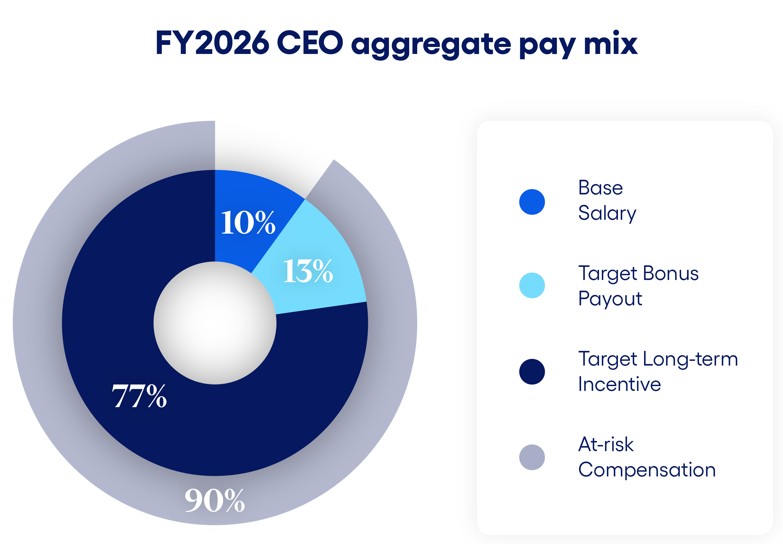 | 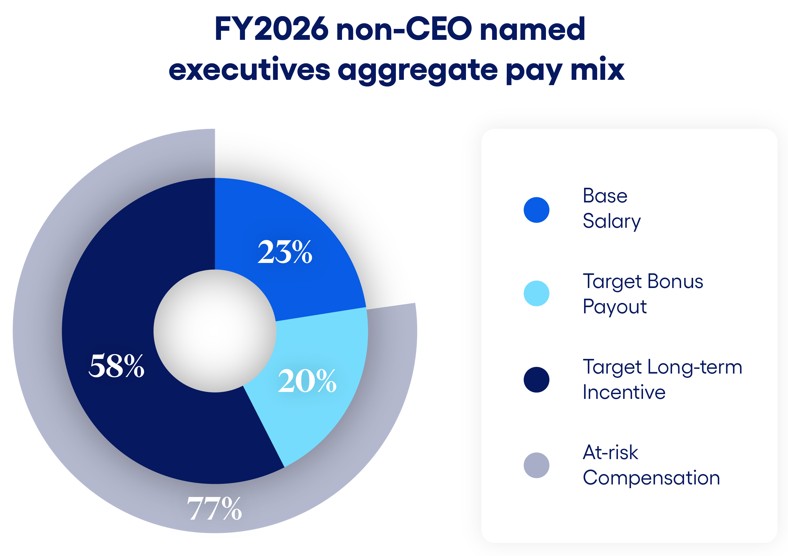 | ||||
28 | 2026 Proxy Statement | | |||||||||
The fiscal 2026 pay mix established by the HC&C Committee places the greatest emphasis on performance-based and at-risk pay while balancing the need for retention, and particularly emphasized long-term performance by the Company. The pay mix was intended to ensure that the Named Executives remained highly focused on the long-term success of the Company.
On December 17, 2025, the HC&C Committee granted a one-time additional restricted stock unit award to Ms. Carsley to encourage her retention as an executive of the Company and in recognition of her high performance, leadership, and value to the Company during the prior three years of her holding the position of Chief Financial Officer. This award consisted of 5,350 restricted stock units, vesting in five equal annual installments beginning on the first anniversary of the grant date based on continued service with the Company.
Total Shareholder Return, Organic Revenue Growth, Non-GAAP Adjusted Operating Margin Expansion, and Results of Fiscal 2024 Performance Share Awards
In fiscal 2024, the HC&C Committee made three separate performance share grants to our then named executive officers (“2024 Named Executives”) based on three separate measures of comparative performance. One was based on relative total shareholder return ("TSR"), one was based on the Company’s compound annual growth rate (“CAGR”) for non-GAAP adjusted revenue (“Organic Revenue Growth”), and one was based on the Company's non-GAAP adjusted operating margin expansion (“Operating Margin Expansion”).
TSR is calculated as (i) the sum of change in stock price plus dividends over the measurement period, divided by (ii) the beginning stock price. This calculation assumes reinvestment of dividends. Our TSR performance has a meaningful and direct impact on the compensation earned by our 2024 Named Executives. The TSR performance share grant comprised approximately 60% of the total performance share grant target value. The TSR performance share grant in fiscal 2024 vested at the end of three years based on TSR over the three-year period in comparison to the companies in our Compensation Peer Group plus the Reference Peers (together, the “2024 TSR Peer Group”). The Company produced a TSR of -15.62% over the three-year period ending June 30, 2026, using the average closing price of the last 30 calendar days of fiscal 2026. The median three-year TSR for the 2024 TSR Peer Group was -14.59%, with our TSR resulting in an achievement of the 38th percentile against the fiscal 2024 TSR Peer Group, which correlated to a final payout of 62.5% of the 2024 Named Executive’s target TSR performance shares.
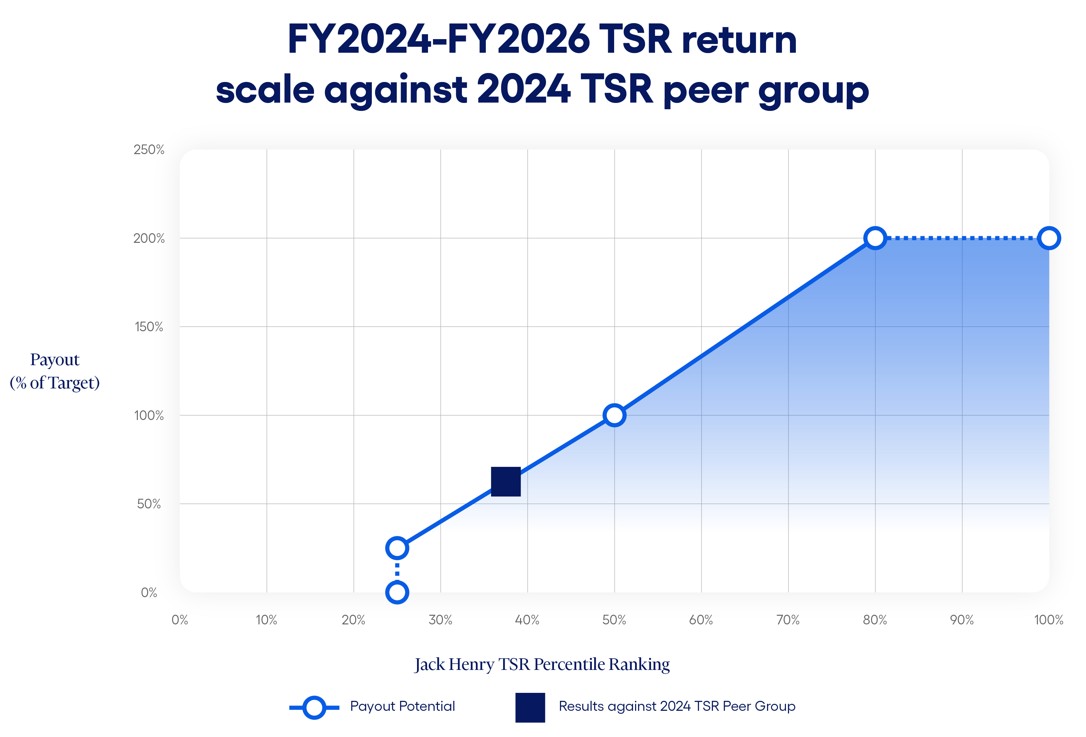
| 2026 Proxy Statement | 29 | |||||||||
The Organic Revenue Growth performance share grant comprised approximately 20% of the total fiscal 2024 performance share grant target value and vested at the end of three years based on the Company’s Organic Revenue Growth CAGR, which was adjusted for the impact of deconversion fees and acquisitions and divestitures during the performance period, against a threshold, target, and maximum percentage goal set by the HC&C Committee based on the annual budget of the Company and available forecasts, with the purpose of setting meaningful and challenging targets. The Company produced an Organic Revenue Growth CAGR of 6.85% over the three-year period ending June 30, 2026, resulting in a final payout of 85% of the 2024 Named Executive’s target Organic Revenue Growth performance shares. This result demonstrates that the targets set by the HC&C Committee are challenging and in keeping with the Company’s desire to focus on performance-based and at-risk pay.
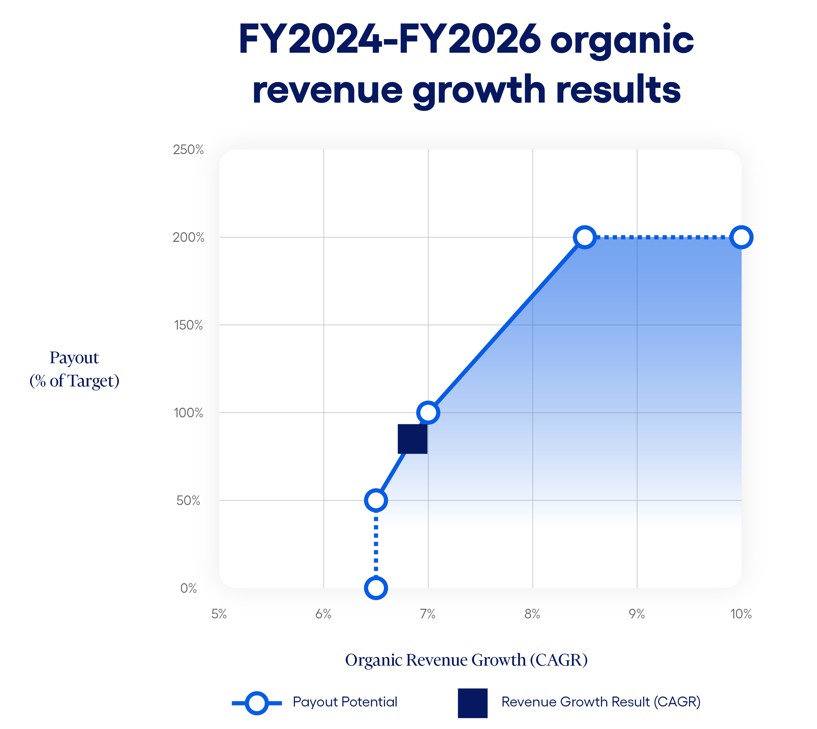
30 | 2026 Proxy Statement | | |||||||||
The Operating Margin Expansion performance share grant comprised approximately 20% of the total fiscal 2024 performance share grant target value and vested at the end of three years based on the Company’s Operating Margin Expansion, which is adjusted for the impact of deconversion fees and acquisitions and divestitures during the performance period, against a threshold, target, and maximum percentage goal set by the HC&C Committee based on the annual budget of the Company and available forecasts, with the purpose of setting meaningful and challenging targets. The Company produced an Operating Margin Expansion of 2.15% over the three-year period ending June 30, 2026, resulting in a final payout of 200% of the 2024 Named Executive’s target Operating Margin Expansion performance shares.
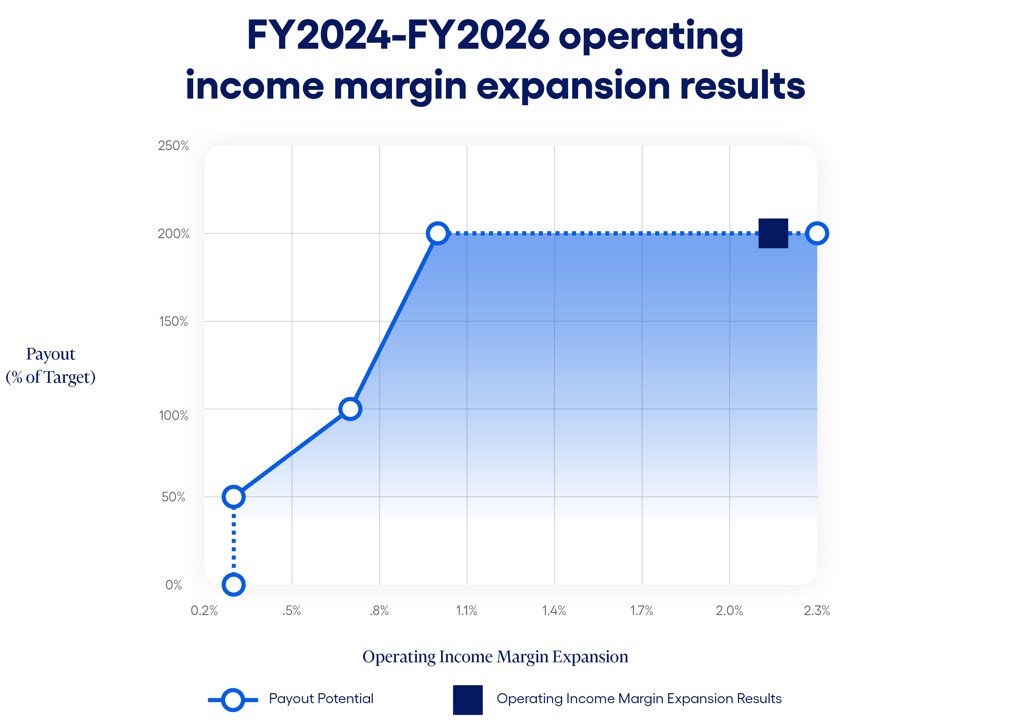
Compensation Philosophy and Objectives
Jack Henry’s compensation philosophy is to offer compensation programs to our executives that:
•Attract and retain highly qualified and motivated executives;
•Encourage esprit de corps and reward outstanding performance;
•Focus executives on achieving consistent earnings growth;
•Encourage continuation of the Company’s entrepreneurial spirit; and
•Reward the creation of stockholder value.
In meeting these objectives, the HC&C Committee strives for the interests of management and stockholders to be the same. To this end, key financial performance measures include adjusted operating income, Organic Revenue Growth, Operating Margin Expansion, and TSR. These measures emphasize a focus on revenue growth, operating efficiencies to yield strong margins, and returns to stockholders in excess of our peers.
The HC&C Committee designs and maintains compensation programs consistent with our executive compensation philosophy to achieve the following objectives:
•To attract, retain, and motivate highly qualified executives by offering compensation programs that are competitive with programs offered by similar companies, including those in our Compensation Peer Group.
•To link performance and executive pay by tying annual cash bonus amounts to achievement of key objectives under the Company’s annual business plans, as well as specific strategic goals.
| 2026 Proxy Statement | 31 | |||||||||
•To reward competitive performance in comparison with peers in our industry.
•To reward the creation of long-term stockholder value through long-term incentive compensation awards and encourage significant stock ownership by senior management to further align executive interests to those of our stockholders.
In pursuit of these objectives, the HC&C Committee believes that the compensation packages provided to the Named Executives should include both cash and equity-based compensation, with an emphasis on at-risk and performance-based pay.
| Compensation Element | Purpose | ||||
| Base salary | •Attract and retain highly qualified executives | ||||
| Annual incentive cash bonus | •Support pay-for-performance orientation •Focus executives on executing the annual operating plan and key financial and non-financial measures of success as established by the Board | ||||
| Long-term incentive compensation | •Align interests of executives and stockholders •Support a stock ownership culture •Drive long-term value creation •Encourage retention of executives | ||||
| Broad-based benefits | •Attract and retain highly qualified executives •Named Executives at Jack Henry participate in the same benefit programs available to our full-time employees | ||||
| Termination provisions | •Align management and stockholder interests to review attractive business alternatives | ||||
Process for Establishing Compensation
The HC&C Committee has overall responsibility for making decisions regarding the compensation of the Named Executives. In determining appropriate compensation levels for the Named Executives, the HC&C Committee meets and deliberates outside the presence of the Named Executives and other members of the executive management team. With respect to the compensation levels for the Named Executives other than the Chief Executive Officer, the HC&C Committee considers input and recommendations from the Chief Executive Officer. Performance reviews of the Named Executives are based on objective and subjective evaluations of individual performance as well as their performance in the preceding fiscal year in achieving Company performance objectives. While our Chief Executive Officer makes recommendations concerning salary adjustments, cash bonus programs, and award amounts for the other Named Executives, the HC&C Committee exercises its discretion and sole authority to set the compensation of each of the Named Executives.
In designing compensation programs and determining compensation levels for the Named Executives for fiscal 2026, the HC&C Committee was assisted by an independent compensation consultant firm. The HC&C Committee engaged Meridian Compensation Partners, LLC (“Meridian”), an independent executive compensation and corporate governance consulting firm, to serve as its independent advisor and compensation consultant with respect to compensation programs for fiscal 2026. The Chair of the HC&C Committee worked directly with Meridian to determine the scope of the work needed to assist the HC&C Committee in its decision-making processes. The engagement of the consulting firm included provision of benchmark comparative data for the Named Executives with respect to base salaries, annual cash bonuses, and long term incentives, in addition to incentive plan design and governance-related matters affecting executive compensation. Meridian was also engaged to provide analysis and advice to the HC&C Committee with respect to the compensation of the Company’s independent directors. The HC&C Committee Chair approves any additional work performed by Meridian on behalf of management. The HC&C Committee has assessed the independence of Meridian and determined that no conflict of interest
32 | 2026 Proxy Statement | | |||||||||
exists under the rules established by the SEC and Nasdaq. The HC&C Committee reviews the independence of its advisors annually.
In making compensation decisions, the HC&C Committee compared each element of total direct compensation against a peer group of publicly traded companies in the software, payments, and data processing industries against which the HC&C Committee believes we compete in the market for executive talent. We collectively refer to this group as the “Compensation Peer Group.” In selecting companies for the Compensation Peer Group, the HC&C Committee has considered multiple criteria, including industry, annual revenue, and market capitalization. For fiscal 2026, the Compensation Peer Group was comprised of the following companies:
| ACI Worldwide, Inc. | Broadridge Financial Solutions, Inc. | Corpay, Inc. | ||||||||||||
| DocuSign, Inc. | Euronet Worldwide, Inc. | ExlService Holdings, Inc. | ||||||||||||
| FactSet Research Systems Inc. | Fair Isaac Corporation | Genpact Limited | ||||||||||||
| Morningstar, Inc. | PTC Inc. | SS&C Technologies Holdings, Inc. | ||||||||||||
| Tyler Technologies, Inc. | Verint Systems Inc. | WEX, Inc. | ||||||||||||
The Compensation Peer Group is reviewed annually and, as appropriate, updated by the HC&C Committee to make sure that members of the group are consistent with the Company’s industry and financial scope and comparable in terms of size and labor pool. For comparison purposes, the Company’s annual revenue, net income, and market capitalization were within a reasonable range of the median of the members of the Compensation Peer Group.
In addition to the Compensation Peer Group, two companies, Fiserv, Inc. and Fidelity National Information Services, Inc. (together, the “Reference Peers”), were identified whose business models more closely align with the Company, but who both have larger revenue and market capitalization. The HC&C Committee used data from both our Compensation Peer Group and our Reference Peers to inform our executive compensation program design and to track current market trends, but only the Compensation Peer Group was used in compensation benchmarking assessments.
To benchmark each element of total compensation for our Named Executives, Meridian provided data from two key sources: (1) public filings for the companies in our Compensation Peer Group and (2) an executive compensation survey reflective of our industry and the general industry. In reviewing compensation survey data, the HC&C Committee considered data for companies with annual revenues similar to the Company.
In setting fiscal 2026 compensation, the HC&C Committee reviewed competitive market data for the Compensation Peer Group at the 25th, 50th, and 75th percentiles for base salary, target bonus, target cash compensation, long-term incentive compensation, and target total compensation. In setting total cash compensation and long-term incentive compensation, the HC&C Committee recognized that there are certain limitations in the market data available for the Compensation Peer Group. Thus, in addition to considering levels of compensation suggested by market data, the HC&C Committee also considered other relevant factors including performance against pre-identified objectives under business plans for the preceding fiscal year, individual performance reviews, change in job duties, and internal equity for compensation levels among our executives.
| 2026 Proxy Statement | 33 | |||||||||
The allocation between cash, non-cash, short-term, and long-term incentive compensation is measured against the practices of our Compensation Peer Group and Reference Peers and reflects the HC&C Committee’s determination of the appropriate compensation mix among base pay, target annual cash incentives, and long-term equity incentives to encourage retention and performance. Actual cash and equity incentive awards are determined by the performance of the Company, the executives as a group, and the individual, depending on the type of award, compared to established goals.
Base Salary
Although we believe a significant portion of executive compensation should be based on “at-risk” compensation to align pay and performance, the HC&C Committee also believes that competitive base salaries are necessary to attract and retain a highly qualified and effective executive team. In June 2025, the HC&C Committee considered competitive data provided by Meridian. Based on this data as well as individual and corporate performance and changes in executive duties, the HC&C Committee increased the base salaries of the Named Executives in the following amounts. Fiscal 2026 base salary changes for Mr. McLachlan and Mr. Morgan went into effect on July 1, 2025. Fiscal 2026 base salary changes for the other Named Executives did not go into effect until January 2026.
| Named Executive | Fiscal 2025 Base Salary ($) | Fiscal 2026 Base Salary ($) | Increase | ||||||||
| Gregory R. Adelson | 750,000 | 775,000 | 3.3 | % | |||||||
| Mimi L. Carsley | 533,283 | 550,000 | 3.1 | % | |||||||
| Craig K. Morgan | 451,758 | 496,934 | 10.0 | % | |||||||
| Shanon G. McLachlan | 450,000 | 486,000 | 8.0 | % | |||||||
| Renee A. Swearingen | 315,180 | 324,635 | 3.0 | % | |||||||
Annual Incentive Cash Bonuses
Annual Incentive Plan
It is our practice to provide our Named Executives with the opportunity to earn annual incentive cash bonus compensation through programs that reward attainment of key objectives under corporate annual business plans. The objectives that underlie our annual incentive compensation programs may vary between fiscal years and between the Named Executives, but generally include objectives that reward attainment by the Company of targeted adjusted operating income as well as strategic executive goals. In setting the fiscal 2026 bonus amounts a Named Executive is eligible to earn for achieving specified objectives, the HC&C Committee considered published survey data and targeted bonus and target total cash compensation levels at or near the 50th percentile of the Compensation Peer Group. Bonus opportunities for achieving objectives are generally established as a percentage of an executive’s base salary and the percentages increase with job scope and complexity. Executives have the opportunity to earn reduced bonus amounts if a minimum level (threshold) of performance against an objective is achieved and can also earn increased bonus amounts for performance in excess of the level of targeted performance (subject to a maximum of 200% of the established target amount).
The decision as to whether to offer an annual incentive cash bonus program to our Named Executives for any fiscal year, the type and funding of any program offered, and the objectives that underlie any program, are subject to the discretion of the HC&C Committee and its assessment of general and industry specific conditions existing during the applicable period. In determining the amount that a Named Executive is eligible to earn under an incentive cash bonus program, the HC&C Committee may also exercise negative discretion to reduce an award based on its assessment of the executive’s contribution and accountability for the objectives that are the subject of the bonus, the internal equity of the executive’s bonus opportunity
34 | 2026 Proxy Statement | | |||||||||
as compared to bonus opportunities for our other executives, and any other factors the HC&C Committee considers relevant.
To provide an appropriate structure for cash bonus incentives, the Company’s stockholders previously approved the 2017 Annual Incentive Plan. Cash bonus incentives for fiscal 2026 were structured under the 2017 Annual Incentive Plan.
The fiscal 2026 incentive cash bonus plan established for the Named Executives was based 75% upon achievement of the Company’s annual adjusted budget operating income target and 25% upon the achievement of strategic executive goals set for the Named Executives as a group by the HC&C Committee. For fiscal 2026, the HC&C Committee established a set of strategic goals for the Named Executives. The achievement of these strategic executive goals is based on the HC&C Committee’s holistic determination of the performance of all strategic executive goals in the aggregate, with one payout factor determined based on the HC&C Committee assessment between 0% and 200% of target. In addition, the strategic executive goals portion of the plan is subject to an individual modifier for each specific Named Executive based on the HC&C Committee’s evaluation. This individual modifier can increase or decrease the strategic executive goal outcome 25% up or down for that Named Executive. The entire incentive cash bonus payout is limited to 200% of target for each Named Executive, even if the combined operating income target achievement and the strategic executive goal achievement, with applicable individual modifier, exceeds 200%. However, the fiscal 2026 annual incentive plan provided that no part of the incentive cash bonus was payable unless the Company’s performance on the adjusted operating income measurement was at or above the minimum threshold for achievement.
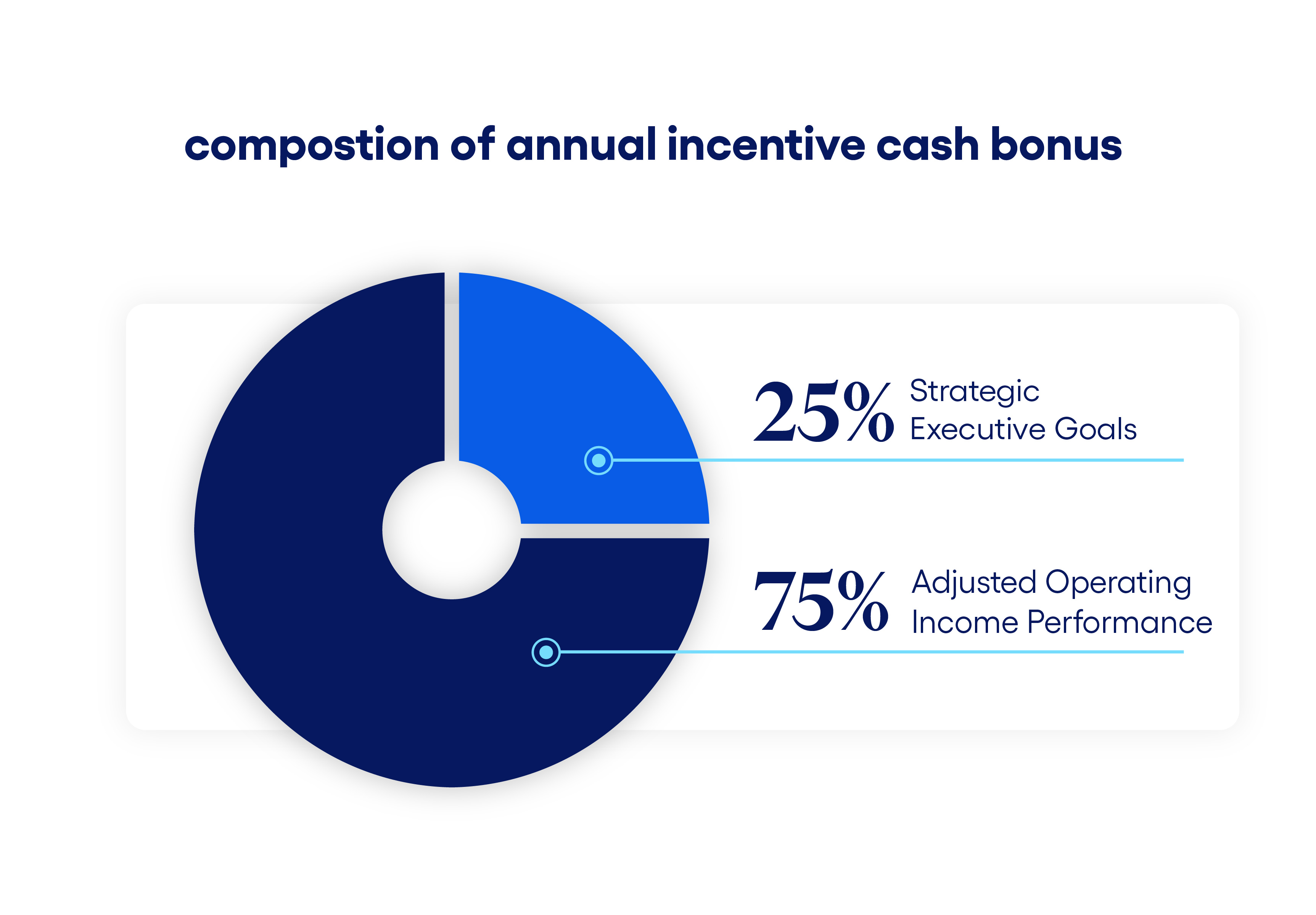
The adjusted operating income performance target for the Named Executives in fiscal 2026, which achievement composes 75% of the targeted annual incentive cash bonus, was established from the annual budget of the Company as approved by the Board of $579.5 million of adjusted operating income. The annual budget was developed by management with input from the Board in a thorough process that builds upon departmental forecasts and considers historical performance, industry dynamics, and macro-economic trends. This $579.5 million of adjusted operating income was reached by adjusting the approved GAAP operating income target of $599.1 million to remove $12.8 million of anticipated operating income from deconversion fees during the fiscal year and removing $6.8 million of anticipated gain on sale of assets.
The HC&C Committee designed the fiscal 2026 annual incentive cash bonus plan to require that the adjusted operating income after all bonuses are paid be no less than $579.5 million. Based on $31.8 million of anticipated amounts to be expensed as target corporate bonuses that are dependent on achievement of certain operating income performance levels in the fiscal year, and accounting for the average strategic executive goal achievement including individual modifiers in fiscal 2026 of greater than 100% as described below, the 100% payout target for adjusted operating income before bonus payments was $611.2 million. For purposes of the determining payouts under the annual incentive cash bonus plan, the HC&C Committee
| 2026 Proxy Statement | 35 | |||||||||
adjusts operating income to remove the impact of deconversion fees, acquisitions and divestitures, sales of assets, and, as approved by the HC&C Committee, any other one-time non-GAAP adjustments that management makes in the Company’s earnings releases for the relevant periods.
Because annual bonuses may only be paid out to the extent post-bonus adjusted operating income exceeds the $579.5 million threshold, the threshold for adjusted operating income pre-bonus is a function of total bonus pool size, rather than a set percentage of target. For fiscal 2026, the pre-bonus adjusted operating income threshold was 94.8% of target, below which no bonus was payable, with a target amount at 100% and up to a maximum at 110%. Bonus payouts for adjusted operating income achievement ranged from 0% of target at threshold performance to 200% of targeted bonus at maximum performance, with additional breakpoints between threshold and target and between target and maximum.
The adjusted operating income results used for the performance target were calculated by adjusting the actual operating income results for fiscal 2026 of $635.0 million to remove operating income related to non-GAAP adjustments as applied by management in financial earnings releases and as approved by the HC&C Committee. These adjustments included removing deconversion fees during the fiscal year of $30.0 million, gain on assets of $3.9 million, and adding back amounts expensed as corporate bonuses at June 30, 2026 of $36.3 million, which were dependent upon or made as a result of achievement of certain operating income performance levels in the fiscal year. This outcome of $637.5 million of pre-bonus adjusted operating income in fiscal 2026, or 104.3% of target, resulted in a 124.4% payout of target for the Named Executives.
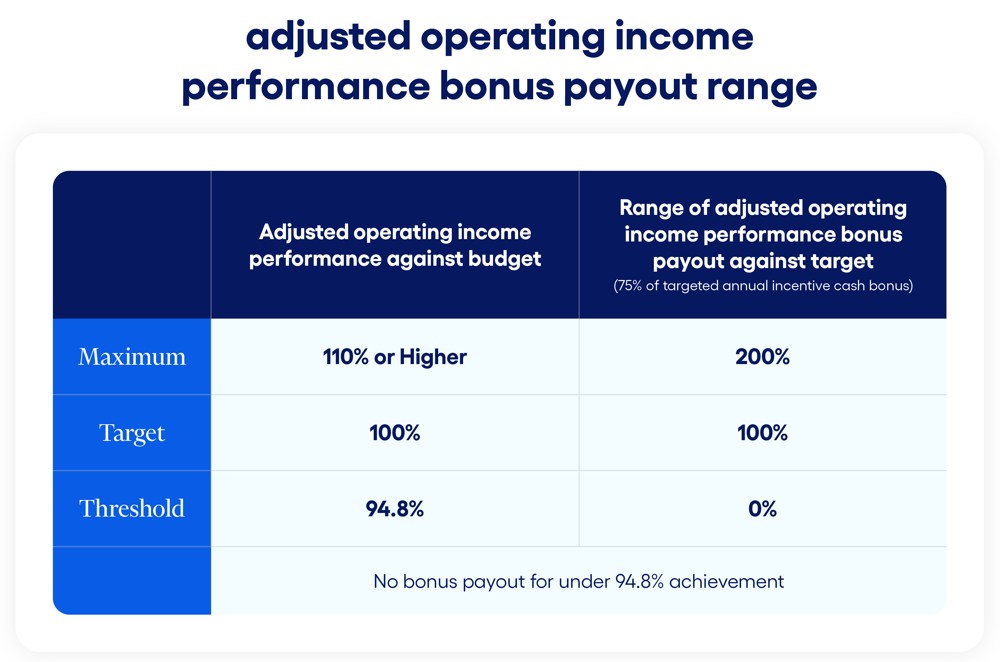
The strategic executive goals, which compose 25% of the targeted annual incentive cash bonus, were set by the HC&C Committee based on the Company’s business strategies and objectives. For fiscal 2026, the HC&C Committee adopted six strategic goals for the Named Executives, which included achieving specified customer and employee satisfaction ratings, delivery of important corporate initiatives, milestones and product delivery timelines, implementing process and control improvements, achieving customer sales targets, and meeting certain internal performance budget targets. These strategic goals are keys to financial and business success for the Company and thus contribute to producing income and stockholder returns over the long-term. The HC&C Committee grades the strategic payout based on a holistic determination of all goals in the aggregate, with one payout factor determined based on the HC&C Committee’s assessment. Based on exceeding benchmark scores for customer and employee satisfaction and engagement ratings, meeting or exceeding implementation schedules for identified initiatives and products, execution on process and control improvements, exceeding customer sales targets, and exceeding internal performance budget targets, the HC&C Committee determined that the six strategic executive goals for the Named Executives earned a payout of 150% of target.
36 | 2026 Proxy Statement | | |||||||||
Potential bonus payouts related to the strategic executive goals range from 0% to 200%. The maximum bonus was intended to be payable only upon truly superior performance. The HC&C Committee intended for this bonus plan to provide a strong incentive for management to meet and exceed budgetary income and identified strategic goals in fiscal 2026.
The strategic executive goals payout factor applies to all Named Executives, but is also subject to an individual modifier of up to 25% increase or decrease as determined by the HC&C Committee. The individual modifier is applicable in situations of significant under- or over-performance by an individual. In fiscal 2026, the HC&C Committee determined to not apply a positive or negative individual modifier to any Named Executive's strategic executive goal attainment percentage.
The full fiscal 2026 incentive bonuses paid, including amounts paid for achievement of individual performance goals, were as follows:
| Named Executive | Target Annual Incentive (as % of base) | Performance on Incentive Measures | Annual Incentive Payout - FY2026 | |||||||||||||||||
Adjusted Operating Income Performance (75% of Bonus) | Strategic Executive Goals Performance (25% of Bonus) | % of Target | Amount ($) | |||||||||||||||||
| Gregory R. Adelson | 125% | 124.4% | 150% | 130.8% | 1,267,125 | |||||||||||||||
| Mimi L. Carsley | 100% | 124.4% | 150% | 130.8% | 719,400 | |||||||||||||||
| Craig K. Morgan | 90% | 124.4% | 150% | 130.8% | 584,990 | |||||||||||||||
| Shanon G. McLachlan | 90% | 124.4% | 150% | 130.8% | 572,119 | |||||||||||||||
| Renee A. Swearingen | 50% | 124.4% | 150% | 130.8% | 212,312 | |||||||||||||||
The HC&C Committee continues to believe that annual cash bonus opportunities are highly effective motivators for management employees and are instrumental in obtaining excellent performance in comparison with the Company’s competitors in both strong and weak economic environments.
The HC&C Committee will in future years continue to thoroughly review the effects of the bonus plan on results achieved and will make any changes to the bonus plan deemed necessary.
Long-Term Incentive Compensation
We believe that equity awards have been instrumental in building the Company, retaining talent, and encouraging management to take a long-term view with regard to strategic decisions they face. Equity awards also help focus executive and employee attention on managing the Company from the perspective of an owner with an equity stake in the business. The HC&C Committee has the authority to grant restricted stock awards of various types and to determine the terms of the restrictions on granted shares. Starting in fiscal 2020, the long-term incentive awards have consisted of a mix of performance shares and time-based restricted stock units. In fiscal 2026, the HC&C Committee allocated the long-term incentive award value at approximately 60% performance shares and 40% time-based restricted stock units. The HC&C Committee determined this mix was appropriate to ensure our Named Executives are aligned with stockholders through stock ownership and also to encourage retention.
| 2026 Proxy Statement | 37 | |||||||||
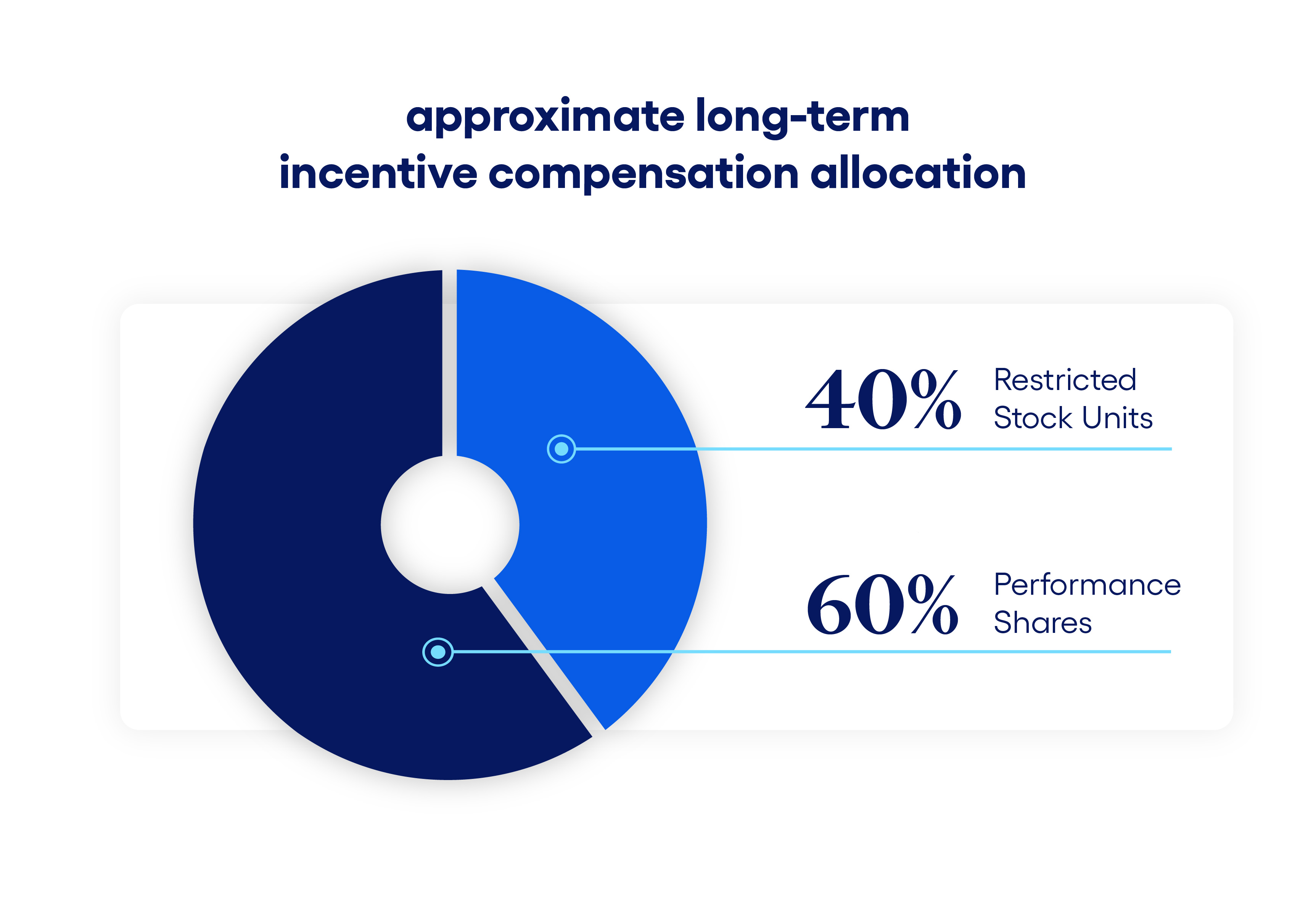
The fiscal 2026 total grant amounts for long-term incentive compensation were determined with reference to comparable aggregate grants of long-term incentive compensation by other members of the Compensation Peer Group and published survey data and were roughly targeted at the 50th percentile of the Compensation Peer Group. The aggregate target value was then divided with approximately 60% applied to performance share awards and approximately 40% applied to time-based restricted stock unit awards.
In determining the level of award for a Named Executive, the HC&C Committee also considers relevant factors such as achievement of previously identified objectives, the executive’s performance, the current equity ownership and equity awards held by the individual executive, and the internal equity of the level of award granted to the executive compared to awards granted to other executives. In reviewing the award levels for our Named Executives, the HC&C Committee believes it is appropriate to consider the Company’s performance against key objectives under its corporate business plan for the preceding fiscal year, including objectives related to revenue and earnings targets, and whether the Company’s performance during the preceding fiscal year benefited stockholders as measured by the market price of the Company’s common stock. In administering the equity compensation programs, the HC&C Committee considers the dilutive effect of the Company’s aggregate equity awards during any fiscal year.
Performance Shares
A portion of the grants to the Named Executives for fiscal 2026 were structured as performance shares that vest only on the achievement of Company performance goals and thus strongly reflect the principle of pay-for-performance. A grant of performance shares is a contractual right to receive stock and/or cash in the future if vesting conditions are met. In fiscal 2026, the HC&C Committee decided to utilize three separate measures of comparative performance to determine the vesting amount of performance shares. These three specific grants of performance shares in fiscal 2026 to the Named Executives vest at the end of a three-year performance period based on the following: (1) the total shareholder return over the three-year period in comparison to the companies in the S&P 900 (“TSR Peer Group”) (comprising approximately one-third of the total performance shares grant value); (2) the Company’s compound organic annual revenue growth rate (“CAGR”) for revenue calculated over four periods (three consecutive one-year periods and one three-year period, with each period accounting for one-quarter each of the total goal), with the revenue for each period measured against a target Organic Revenue Growth CAGR, where Organic Revenue Growth removes the impact of deconversion fees, acquisitions and divestitures, and, as approved by the HC&C Committee, any other one-time non-GAAP adjustments that management makes in the Company’s earnings releases for the relevant periods (comprising approximately one-third of the total performance
38 | 2026 Proxy Statement | | |||||||||
shares grant value); and (3) the expansion of the Company’s non-GAAP adjusted operating margin calculated over four periods (three consecutive one-year periods and one three-year period, with each period accounting for one-quarter each of the total goal), with such margin for each period measured against a target non-GAAP adjusted operating margin expansion, where non-GAAP operating margin removes the impact of deconversion fees, acquisitions and divestitures, sales of assets, and, as approved by the HC&C Committee, any other one-time non-GAAP adjustments that management makes in the Company’s earnings releases for the relevant periods (comprising approximately one-third of the total performance shares grant value).
For the purpose of the TSR grants, TSR was defined as ending stock price minus beginning stock price (adjusted for splits and similar changes) plus dividends per share paid over the performance period, all divided by the beginning stock price. A target amount of stock was set for each Named Executive that may be earned if TSR at the end of the three-year period is at the 50th percentile in comparison to the TSR Peer Group. Vesting ranges from 50% of target performance shares at the 25th percentile to the maximum amount of the grant (200% of target) at or above the 80th percentile relative to the TSR Peer Group. No shares will vest if performance is below the 25th percentile threshold.
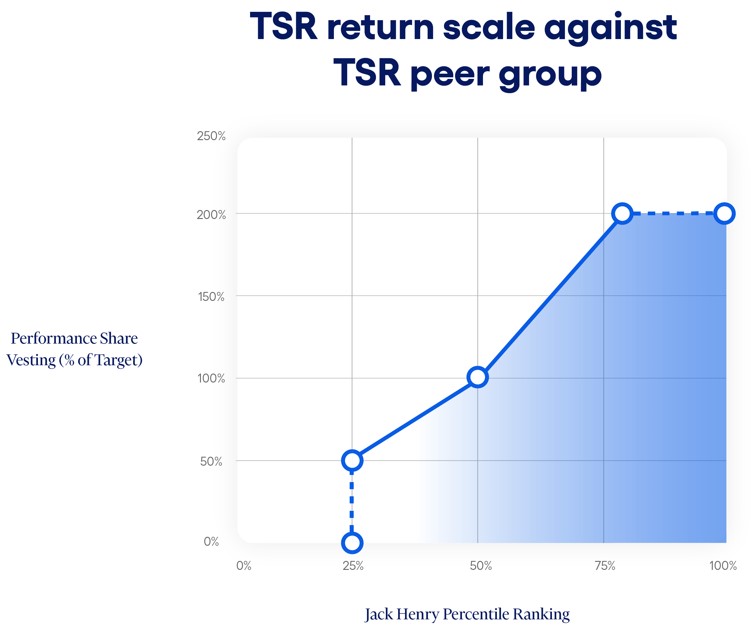
For purposes of the three-year Organic Revenue Growth CAGR grants, the following principles apply:
•non-GAAP adjusted revenue is calculated by adjusting GAAP revenue for deconversion fee revenue, acquisitions and divestitures, and, as approved by the HC&C Committee, any other one-time non-GAAP adjustments that management makes in the Company’s earnings releases, for the relevant periods;
•one-year Organic Revenue Growth is calculated by (a) the quotient equal to the Company's non-GAAP adjusted revenue for the fiscal year covered by the applicable one-year period and dividing it by the lesser of (i) the Company's non-GAAP adjusted revenue for the fiscal year ending immediately prior to the beginning of the one-year period and (ii) only for year two or three of the performance period, the number that would represent goal achievement for the prior year period at maximum performance, and (b) subtracting one;
•three-year Organic Revenue Growth is calculated by (a) the quotient equal to the Company’s non-GAAP adjusted revenue for the final fiscal year of the performance period and dividing it by the Company’s non-GAAP adjusted revenue for the fiscal year ending immediately prior to the beginning of the performance period, (b) raised to an exponent of one-third, and (c) subtracting one; and
•an acquisition or divestiture by the Company during the performance period will result in an adjustment to the goal, base year results, and/or final year results, as appropriate, by the HC&C
| 2026 Proxy Statement | 39 | |||||||||
Committee to ensure the grant results are not materially benefited nor penalized by the acquisition or divestiture.
The HC&C Committee set a threshold, target, and maximum for both the three-year and one-year Organic Revenue Growth CAGR percentage goal based on the annual budget of the Company and available forecasts and with the purpose of setting meaningful and challenging targets, with vesting for performance shares ranging from 50% of target at threshold performance, 100% of target at target performance, and 200% of target at maximum performance and above. For the fiscal 2026 Organic Revenue Growth CAGR grants, threshold was set for both the three-year period and the one-year periods at 5.5%, target was set at 6.5%, and maximum was set at 7.5%. No performance shares vest for achievement below threshold.
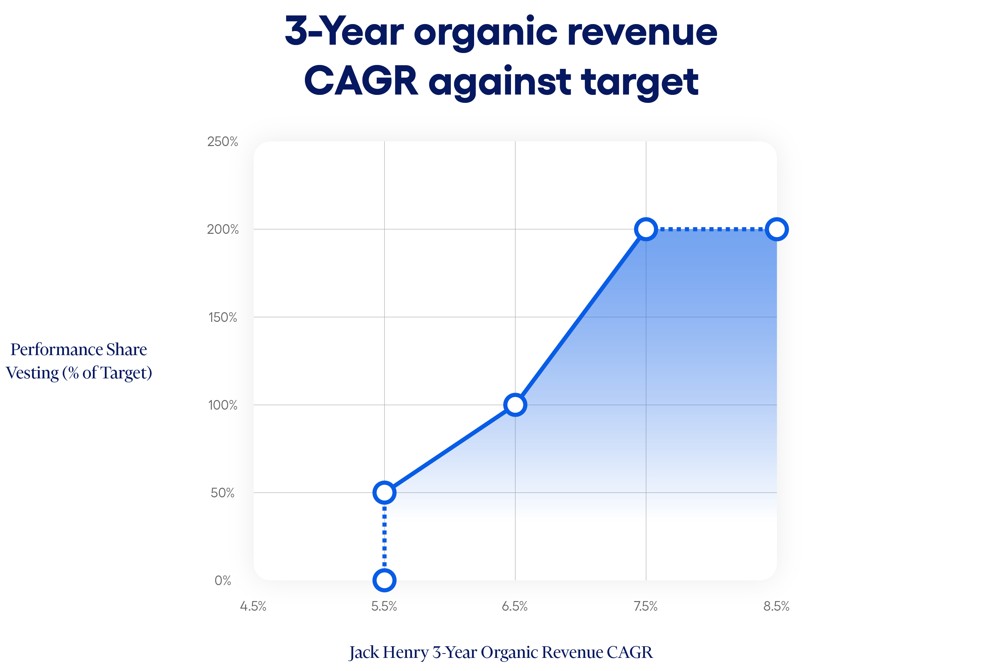
For purposes of the three-year non-GAAP adjusted operating margin expansion grants, the following principles apply:
•non-GAAP adjusted revenue is calculated by adjusting GAAP revenue for deconversion fee revenue, acquisitions and divestitures, and, as approved by the HC&C Committee, any other one-time non-GAAP adjustments that management makes in the Company's earnings releases, for the relevant periods;
•non-GAAP adjusted operating income is calculated by adjusting GAAP operating income for operating income from deconversion fees and operating income/loss from acquisitions, divestitures, sales of assets, and, as approved by the HC&C Committee, any other one-time non-GAAP adjustments that management makes in the Company's earnings releases, for the relevant periods;
•one-year non-GAAP adjusted operating margin expansion is calculated by (a) an amount equal to non-GAAP adjusted operating income for the final fiscal year of the performance period divided by non-GAAP adjusted revenue for the final fiscal year of the performance period, minus (b) (i) for the first one-year period, the non-GAAP operating income divided by non-GAAP revenue for the prior fiscal year, (ii) for the second and third one-year periods, (A) the lesser of the actual non-GAAP operating income from the prior year or the non-GAAP operating income number that would represent goal achievement for the prior year period at maximum performance, divided by (B) the actual non-GAAP revenue for the prior year period;
•three-year non-GAAP adjusted operating margin expansion is calculated by (a) an amount equal to non-GAAP adjusted operating income for the final fiscal year of the performance period divided by non-GAAP adjusted revenue for the final fiscal year of the performance period, less (b) an amount equal to non-GAAP adjusted operating income for the fiscal year ending immediately prior to the beginning of the performance period divided by non-GAAP adjusted revenue for the fiscal year ending immediately prior to the beginning of the performance period; and
40 | 2026 Proxy Statement | | |||||||||
•an acquisition or divestiture by the Company during the performance period will result in an adjustment to the goal, base year results, and/or final year results, as appropriate, by the HC&C Committee to ensure the grant results are not materially benefited nor penalized by the acquisition or divestiture.
The HC&C Committee set a threshold, target, and maximum for both the three-year and one-year non-GAAP adjusted operating margin expansion percentage goal based on the annual budget of the Company and available forecasts and with the purpose of setting meaningful and challenging targets, with vesting for performance shares ranging from 50% of target at threshold performance, 100% of target at target performance, and 200% of target at maximum performance and above. For the fiscal 2026 non-GAAP adjusted operating margin expansion grants, the three-year period threshold was set at 0.3%, target was set at 0.75%, and maximum was set at 1.05%. For the three one-year periods, threshold, target, and maximum were set at one-third of the three-year period numbers, at 0.1%, 0.25%, and 0.35%, respectively. No performance shares vest for achievement below threshold.
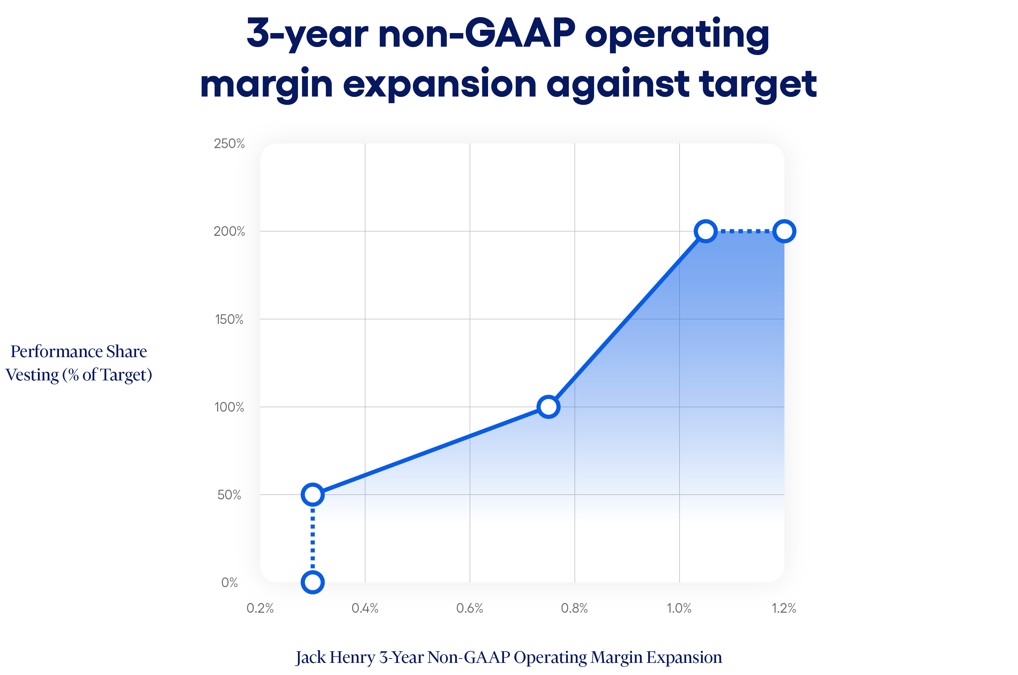
The fiscal 2026 awards were structured to provide incentives for long-term performance and retention. Retention is encouraged by grant terms which immediately forfeit all awards that have not vested in the event that the grantee’s employment with the Company is terminated for any reason other than in the event of death, incapacity, retirement, or in connection with any change in control.
The use of performance shares allows for flexibility in addressing the orderly retirement of grantees. The fiscal 2026 performance share awards contain terms which allow for the pro-rata vesting of awards upon retirement based on full months of service following the date of grant. For this purpose, retirement is defined as termination with the stated purpose of retirement, for which the grantee has provided the Company at least six months’ prior notice and occurs (1) on or after the age of 55 and following a minimum number of years of employment with the Company such that the grantee’s age plus the number of full years of employment with the Company equals or exceeds 72, or (2) on or after age 65. With respect to a retirement during the term, at the end of the three-year term of the grant, the award will be calculated, and a pro-rata portion will be settled to the grantee based on completed full months of service. For example, if an eligible grantee retires 18 months after the grant date, he or she would be credited with 18 months of service and would be entitled to one-half of any amount that vests on performance measured at the end of the three-year grant. Death or incapacity of a grantee is addressed in the same manner, with pro-rata vesting based on completed months of service. Upon a change in control of the Company and a qualified termination of the grantee, the target number of performance shares (or, with respect to TSR grants, if higher, the number
| 2026 Proxy Statement | 41 | |||||||||
of shares that would have vested based on actual TSR achievement if the change in control date were the measuring date for TSR measurement) vest and will be settled, regardless of the performance measures achieved.
Restricted Stock Units
In fiscal 2026, the long-term incentive compensation included restricted stock unit grants to the Named Executives. The fiscal 2026 restricted stock unit awards were structured to provide incentives for long-term performance and retention. The shares vest one-third on each of the three subsequent anniversaries. Retention is encouraged by grant terms which immediately forfeit all awards that have not vested in the event that the grantee’s employment with the Company is terminated for any reason, other than in the event of retirement or in connection with a change in control.
On December 17, 2025, the HC&C Committee granted a one-time additional restricted stock unit award to Ms. Carsley to encourage her retention as an executive of the Company and in recognition of her high performance, leadership, and value to the Company during the prior three years of her holding the position of Chief Financial Officer. This award consisted of 5,350 restricted stock units, vesting in five equal annual installments beginning on the first anniversary of the grant date based on continued service with the Company.
The fiscal 2026 restricted stock unit awards contain terms which allow for continued vesting in accordance with the vesting schedule of all unvested awards upon retirement. For this purpose, retirement is defined as termination with the express reason of retirement, for which the grantee has provided the Company at least six months’ prior notice and occurs (1) on or after the age of 55 and following a minimum number of years of employment with the Company such that the grantee’s age plus the number of full years of employment with the Company equals or exceeds 72, or (2) on or after age 65. The grantee must also remain actively employed as a full-time employee for six months following the date of the award to qualify for such continued vesting. Further, the grantee must abide by certain restrictive covenants, including non-competition, non-solicit, and non-disparagement covenants. Any breach of such restrictive covenants will result in a forfeiture of all remaining non-settled awards. Upon a change in control of the Company and a qualified termination of the grantee, all unvested restricted stock units vest in full and will be settled.
Broad-Based Benefits Programs
The Company offers certain broad-based benefits programs including benefits such as health, dental, disability and life insurance, health care savings accounts, employee stock purchase plan, paid vacation time, and Company matching contributions to a 401(k) Retirement Savings Plan. Benefits are provided to all employees in accordance with practices within the marketplace and are a necessary element of compensation in attracting and retaining employees. We do not offer pensions or supplemental executive retirements plans for our Named Executives.
Termination Benefits Agreements and Executive Severance Plan
On June 30, 2026, each of the Named Executives was a participant in the Executive Severance Plan (the “Severance Plan”) that is discussed in this Proxy Statement under the caption “Agreements with Executive Officers and Potential Payments upon Termination or Change in Control” on page 52. The Severance Plan provides that each Named Executive who experiences a qualifying termination not in connection with a change in control receives severance payments. The amount of such severance payments for the Chief Executive Officer is equal to two times the Chief Executive Officer’s annual base salary, paid ratably over two years, and, for the other Named Executives, one and a half times the Named Executive’s annual base salary, paid ratably over one and a half years. The Named Executives also receive a prorated amount of the annual bonus the Named Executive would have received for the current performance year had the Named Executive remained employed through the end of such performance year, paid in a single lump sum at the same time as annual bonus payments are made to active annual bonus participants for such performance year. The Named Executives would also receive an amount equal to the cost of health benefit continuation
42 | 2026 Proxy Statement | | |||||||||
premiums for 18 months, paid in a lump sum. The treatment of equity awards held by the terminated Named Executive would not be impacted by the Severance Plan, but would be controlled by the terms set out in those individual awards.
The Severance Plan also provides that each Named Executive who experiences a qualifying termination in connection with a change in control receives severance payments. The amount of such severance payments for the Chief Executive Officer is equal to two times the annual base salary and two times the target annual bonus, and, for other Named Executives, one and a half times the annual base salary and one and a half the target annual bonus, also paid in a lump sum. The Named Executives will also receive a lump sum prorated amount of target annual bonus for the year in which the termination occurs and an amount equal to the cost of health benefit continuation premiums for 18 months. Equity awards held by the terminated Named Executive, other than those awards that already contain provisions governing the treatment of the awards in the event of a change in control termination (which will be controlled by the terms of such awards), will fully vest upon a qualifying termination in connection with a change in control, with any performance-based awards vesting as if target-level achievement were met. All Severance Plan payments are conditional upon the terminated executive’s execution and nonrevocation of a release of claims against the Company and adherence to certain restrictive covenants set forth in the Severance Plan.
The benefits provided were determined primarily by reference to comparative data provided to the HC&C Committee by its independent advisor. The benefits are believed by the HC&C Committee to be sufficient to provide the desired incentive and security to retain crucial personnel in a time of disruption and to help attract and retain top executive talent. The change in control benefits provided in the Severance Plan reflect the concern of the Board that any future threatened or actual change in control, such as an acquisition or merger, could cause disruption and harm to the Company in the event of the resulting loss of any of its key executives.
No severance payments are eligible to be paid under the Severance Plan unless a Named Executive’s employment is terminated by the Company without “Cause” or by the Named Executive for “Good Reason” (both as defined in the Severance Plan). The HC&C Committee believes that agreements such as the Severance Plan should not include provisions that would obligate an acquirer of the Company to make large cash payouts to our Named Executives simply because a change in control has occurred. Due to this concern, the occurrence of a change in control event alone will not trigger any cash payment obligations to our Named Executives under the Severance Plan. Change in control severance payment obligations only arise if the Named Executive’s employment is terminated by the Company without “Cause” or by the Named Executive for “Good Reason” within the period commencing 90 days prior to and for two years following a change in control (i.e., “double trigger”). The Company does not provide, nor has it ever provided, excise tax gross-up payments to any employee in the event of a change in control and termination.
The Severance Plan has no set term and will continue until terminated by the HC&C Committee. However, unless a Severance Plan participant consents, generally, the Severance Plan may not be terminated or amended in a manner that is materially adverse to a participant without 12-months’ notice to each participant. As set forth in the Severance Plan, certain exceptions apply where an amendment or termination is in connection with a change in control. The Severance Plan specifies that it does not confer on the executives any right to continued employment and shall not interfere with the right of the Company to terminate the executives at any time.
Deferred Compensation Plan
Under the Company’s non-qualified Deferred Compensation Plan, our Named Executives may voluntarily defer a portion of their compensation to one or more future years. While the plan allows the Company to offer deferral of all types of compensation, including salary, bonus, and equity grants, to date the Company has only offered a program to defer receipt of equity compensation upon vesting of performance shares and restricted stock units. Amounts deferred are deemed invested in investments selected by the participant from a limited number of choices. The Deferred Compensation Plan is intended to promote retention by providing a long-term savings opportunity on a tax-efficient basis. Performance shares or restricted stock units that are deferred under the Company’s Deferred Compensation Plan may be settled in
| 2026 Proxy Statement | 43 | |||||||||
stock or, at the option of the HC&C Committee, in cash. Mr. Morgan participated in the Deferred Compensation Plan in fiscal 2026.
Perquisites
Perquisites represent a minor component of executive compensation. When appropriate, we provide perquisites that we believe are reasonable and competitive. The Company has entered into an aircraft time-sharing agreement with each Named Executive, which permits the Named Executives to lease the Company’s corporate-owned aircraft for personal use on a non-exclusive, time-sharing basis. Pursuant to the time-sharing agreement, the Named Executive would reimburse the Company an amount not more than (a) twice the cost of fuel plus (b) other actual expenses for his or her personal use of the Company’s corporate-owned aircraft, which amount approximates the Company’s incremental costs for the flight. The Company determines incremental costs of a Named Executive's use of a corporate-owned aircraft under the time-sharing agreement by using a method that takes into account all operating costs related to such flights, including aircraft fuel expenses, crew travel expenses, airport expenses, and aircraft maintenance. Because the Company's aircraft is used primarily for business travel, this methodology excludes fixed costs that do not change based on usage, such as salaries for pilots and crew and purchase costs of aircraft. Any difference between the Company's incremental costs for the flight and the amount reimbursed for the flight is considered a perquisite. No time-sharing arrangements were used in fiscal 2026 and there were no other amounts reimbursed.
Stock Ownership Guidelines
The Board established stock ownership guidelines for the Named Executives, other members of management, and the non-employee directors of the Company. These guidelines require each covered individual to hold a number of shares of the Company’s common stock with an aggregate market value that equates to a specified multiple of the employee’s base salary or, in the case of directors, of their annual base retainer. The stock ownership guidelines for the Named Executives are as follows:
| Named Executive | Title | Ownership Requirement as a Multiplier of Base Salary | ||||||
| Gregory R. Adelson | President and Chief Executive Officer | 6x | ||||||
| Mimi L. Carsley | Chief Financial Officer and Treasurer | 3x | ||||||
| Craig K. Morgan | Chief Legal Officer and Secretary | 1x | ||||||
| Shanon G. McLachlan | Senior Vice President and Chief Operating Officer | 3x | ||||||
| Renee A. Swearingen | Senior Vice President and Chief Accounting Officer | 1x | ||||||
The value of each person’s share holdings for purposes of the guidelines includes Company shares owned outright, as well as all shares held in the person’s retirement accounts and deferral accounts, all shares held in trust for the person’s immediate family members, and all restricted stock units. Stock options and performance shares are not counted for purposes of measuring compliance with the stock ownership guidelines. The HC&C Committee recognizes that executive officers or employees who were recently promoted to executive officer positions and newly elected directors may require some period of time to achieve the guideline amounts. The guidelines, therefore, contemplate a five-year transition period for acquiring a number of shares with the specified market value. The guidelines also require that until the applicable ownership level is achieved, the individual should retain and hold 75% of all shares received from vesting of restricted stock units and performance shares or exercise of options, net of shares sold to pay taxes. The HC&C Committee will continue to monitor the compliance of each executive and director with the guidelines. As measured on June 30, 2026, all covered individuals on such date were in compliance with these guidelines or within the five-year compliance window.
44 | 2026 Proxy Statement | | |||||||||
Trading in Company Securities Policy
The Company has adopted the Trading in Company Securities Policy that is designed to promote compliance with relevant SEC regulations, including insider trading, and applicable Nasdaq listing standards. This policy applies to our directors, officers, and employees, family members of our directors, officers, and employees, contractors and consultants who have access to material nonpublic information about the Company, and entities controlled by such individuals. In addition to prohibiting transactions in Company securities while in possession of material nonpublic information, these insiders are also prohibited from transactions involving short-term or speculative transactions in the Company’s securities, including engaging in short sales, buying or selling of Company options, puts, calls, or other derivative securities, hedging transactions, holding Company securities in margin accounts, pledging Company securities as collateral, or placing standing or limit orders to buy or sell Company securities with a duration in excess of three business days (except under approved Rule 10b5-1 plans).
Executive Compensation Clawback Policy
In November 2023, the Company adopted, in accordance with Nasdaq listing standards, the Executive Compensation Clawback Policy. This policy requires that the Company seek to recover erroneously awarded incentive-based compensation received by any current or former executive officer on or after October 2, 2023, and during the three-year period preceding the date on which the Company is required to prepare an accounting restatement due to material noncompliance of the Company with any financial reporting requirement under securities laws. The prior recoupment policy continues to apply to incentive-based compensation received by executive officers before October 2, 2023. Both recoupment policies are administered by the HC&C Committee.
Polices and Practices Related to the Grant of Certain Equity Awards Close in Time to the Release of Material Nonpublic Information
At regularly scheduled meetings during May through August of each year, the HC&C Committee approves the upcoming fiscal year target total compensation for Named Executives, including base salary, annual incentive cash bonus amounts, and long-term incentive compensation awards. In addition, the HC&C Committee approves the prior fiscal year incentive cash bonus achievement level and payout amounts as well as results and settlement of any performance-based long-term incentive compensation awards.
By established practice, the grant date for the long-term incentive compensation equity awards for Named Executives occurs in early August of each year, prior to the Company’s release of fiscal year-end financial results. It is the Board’s and the HC&C Committee’s belief that maintaining a consistent grant practice is in the best interests of the Company and minimizes the risk that annual awards are granted opportunistically for the benefit of executive officers. For fiscal 2026, Named Executives were granted performance shares and restricted stock units in August 2025. The Company has in the past granted stock option awards to Named Executives, with the last such awards being granted in 2016. Stock option awards are not currently a component of executive compensation design, but it is possible that in the future the HC&C Committee may choose to grant stock option awards to Named Executives.
The HC&C Committee does not take material nonpublic information into account when determining the timing and terms of annual equity award grants. In addition, the Company does not time the disclosure of material nonpublic information for the purpose of affecting the value of executive compensation.
Fiscal 2026 Grants of Certain Equity Awards Close in Time to the Release of Material Nonpublic Information
During fiscal 2026, none of our Named Executives were granted stock option awards.
| 2026 Proxy Statement | 45 | |||||||||
COMPENSATION AND RISK
Under its charter, the HC&C Committee is charged with review of risks related to the Company’s compensation policies and practices. In fiscal 2026, the HC&C Committee directed the Company’s Human Resources Department to conduct a compensation risk assessment and to report the results to the HC&C Committee. The assessment reviewed design features, characteristics, and performance metrics used in compensating all employees of the Company, including salaries, sales incentives, incentive bonus plans, and long-term equity incentive compensation awards. The HC&C Committee reviewed and discussed the report and concluded that the Company’s compensation programs, policies, and practices do not create risks that are reasonably likely to have a material adverse effect on the Company. This conclusion was based on a number of factors, including:
•Compensation of our employees is generally competitive with relevant labor markets.
•Benefits are offered to all eligible employees on a non-discriminatory basis and no material perquisites are offered solely to executives or management.
•Incentive bonuses are determined largely on total Company financial performance and are capped at reasonable levels.
•Long-term equity incentive awards to executives generally vest upon achievement of objective performance standards over a number of years, and thus do not encourage taking excessive risk for short-term gains.
•Compensation of executive and senior managers is a combination of salary, benefits, annual cash incentive bonuses, and long-term equity incentive awards, resulting in appropriate balancing of short and long-term interests and goals.
•Executives are subject to stock ownership guidelines, which align their interests with those of the stockholders.
•The Company has adopted a recoupment policy providing for the clawback of executive compensation in the event of financial restatements.
46 | 2026 Proxy Statement | | |||||||||
EXECUTIVE COMPENSATION
Summary Compensation Table
The following table sets forth certain information with regard to the compensation paid to (1) Mr. Adelson (our Chief Executive Officer during fiscal 2026), (2) Ms. Carsley (our Chief Financial Officer), and (3) Messrs. Morgan and McLachlan and Ms. Swearingen (the Company’s three other most highly compensated executive officers that were serving as executive officers as of the end of fiscal 2026) (collectively, our “Named Executives”) during the fiscal years ended June 30, 2026, 2025, and 2024.
| Name and Principal Position | Year | Salary | Bonus | Stock Awards | Option Awards | Non-Equity Incentive Plan Compensation | All Other Compensation | Total | ||||||||||||||||||
| ($) | ($) | ($) (1) | ($) | ($) (2) | ($) (3) | ($) | ||||||||||||||||||||
Gregory R. Adelson President and Chief Executive Officer | 2026 | 762,500 | - | 6,367,595 | - | 1,267,125 | 16,750 | 8,413,970 | ||||||||||||||||||
| 2025 | 750,000 | - | 5,306,749 | - | 938,906 | 21,337 | 7,016,992 | |||||||||||||||||||
| 2024 | 580,750 | - | 2,038,836 | - | 611,573 | 16,788 | 3,247,947 | |||||||||||||||||||
Mimi L. Carsley Chief Financial Officer and Treasurer | 2026 | 541,641 | - | 3,292,745 | - | 719,400 | 17,918 | 4,571,704 | ||||||||||||||||||
| 2025 | 525,516 | - | 1,980,866 | - | 534,083 | 20,576 | 3,061,041 | |||||||||||||||||||
| 2024 | 496,375 | - | 1,684,218 | - | 577,097 | 26,506 | 2,784,196 | |||||||||||||||||||
Craig K. Morgan Chief Legal Officer and Secretary | 2026 | 496,934 | - | 1,054,531 | - | 584,990 | 18,629 | 2,155,084 | ||||||||||||||||||
| 2025 | 445,179 | - | 958,716 | - | 407,192 | 17,579 | 1,828,666 | |||||||||||||||||||
| 2024 | 434,300 | - | 938,072 | - | 411,615 | 19,403 | 1,803,390 | |||||||||||||||||||
Shanon G. McLachlan (4) Senior Vice President and Chief Operating Officer | 2026 | 486,000 | - | 1,289,283 | - | 572,119 | 15,970 | 2,363,372 | ||||||||||||||||||
| 2025 | 450,000 | - | 1,061,352 | - | 405,608 | 20,517 | 1,937,477 | |||||||||||||||||||
| Renee A. Swearingen (4) Senior Vice President and Chief Accounting Officer | 2026 | 319,908 | - | 309,835 | - | 212,312 | 17,736 | 859,791 | ||||||||||||||||||
(1)Reflects grants of performance shares and restricted stock units on August 4, 2023, August 4, 2024, and August 4, 2025, under the Company’s Equity Incentive Plan to the Named Executives. The 2026 amount for Ms. Carsley includes a one-time additional grant of restricted stock units on December 17, 2025. See page 29 for further information on Ms. Carsley's additional grant of restricted stock units. Information about the assumptions used to determine the fair value of equity awards is set forth in our Annual Report on Form 10-K in Note 10 to our consolidated financial statements for the year ended June 30, 2026.
(2)Reflects amounts paid to the Named Executives following the end of the fiscal year based upon achievement of performance goals under the Company’s Annual Incentive Plans. These amounts were earned and accrued in the fiscal year listed and paid in the following fiscal year.
(3)Reflects matching contributions to the individual’s accounts pursuant to the Company’s 401(k) Retirement Savings Plan (the “Retirement Plan”).
(4)Mr. McLachlan was not a Named Executive during fiscal 2024. Ms. Swearingen was not a Named Executive during fiscal 2024 or fiscal 2025.
Grants of Plan-Based Awards Table
The following table presents information on awards granted to the Named Executives during the fiscal year ended June 30, 2026 under our 2017 Annual Incentive Plan with respect to performance targets set for fiscal 2026 and our 2015 Equity Incentive Plan with respect to grants of performance shares and restricted stock units made during fiscal year 2026 on or prior to November 10, 2025, and our 2025 Equity Incentive Plan with respect to grants of performance shares and restricted stock units made during fiscal year 2026 after November 10, 2025.
| 2026 Proxy Statement | 47 | |||||||||
| Name | Grant Date | Estimated Future Payouts Under Non- Equity Incentive Plan Awards (1) | Estimated Future Payouts Under Equity Incentive Plan Awards (2) | All Other Stock Awards: Number of Shares of Stock or Units | Grant Date Fair Value of Stock and Option Awards | ||||||||||||||||||||||||
| Threshold ($) | Target ($) | Maximum ($) | Threshold (#) | Target (#) | Maximum (#) | (#)(3) | ($)(4) | ||||||||||||||||||||||
| Gregory R. Adelson | 8/4/2025 | 0 | 968,750 | 1,937,500 | - | - | - | - | - | ||||||||||||||||||||
| 8/4/2025 | - | - | - | 3,587 | 7,174 | 14,348 | - | 1,475,548 | |||||||||||||||||||||
| 8/4/2025 | - | - | - | 3,587 | 7,173 | 14,346 | - | 1,279,683 | |||||||||||||||||||||
| 8/4/2025 | - | - | - | 3,587 | 7,173 | 14,346 | - | 1,279,683 | |||||||||||||||||||||
| 8/4/2025 | - | - | - | - | - | - | 14,347 | 2,332,681 | |||||||||||||||||||||
| Mimi L. Carsley | 8/4/2025 | 0 | 550,000 | 1,100,000 | - | - | - | - | - | ||||||||||||||||||||
| 8/4/2025 | - | - | - | 1,314 | 2,627 | 5,254 | - | 540,321 | |||||||||||||||||||||
| 8/4/2025 | - | - | - | 1,313 | 2,626 | 5,252 | - | 468,471 | |||||||||||||||||||||
| 8/4/2025 | - | - | - | 1,314 | 2,627 | 5,254 | - | 468,676 | |||||||||||||||||||||
| 8/4/2025 | - | - | - | - | - | - | 5,253 | 854,085 | |||||||||||||||||||||
| 12/17/2025 | - | - | - | - | - | - | 5,350 | 961,192 | |||||||||||||||||||||
| Craig K. Morgan | 8/4/2025 | 0 | 447,241 | 894,481 | - | - | - | - | - | ||||||||||||||||||||
| 8/4/2025 | - | - | - | 594 | 1,188 | 2,376 | - | 244,348 | |||||||||||||||||||||
| 8/4/2025 | - | - | - | 594 | 1,188 | 2,376 | - | 211,935 | |||||||||||||||||||||
| 8/4/2025 | - | - | - | 594 | 1,188 | 2,376 | - | 211,935 | |||||||||||||||||||||
| 8/4/2025 | - | - | - | - | - | - | 2,376 | 386,314 | |||||||||||||||||||||
| Shanon G. McLachlan | 8/4/2025 | 0 | 437,400 | 874,800 | - | - | - | - | - | ||||||||||||||||||||
| 8/4/2025 | - | - | - | 727 | 1,453 | 2,906 | - | 298,853 | |||||||||||||||||||||
| 8/4/2025 | - | - | - | 726 | 1,452 | 2,904 | - | 259,052 | |||||||||||||||||||||
| 8/4/2025 | - | - | - | 726 | 1,452 | 2,904 | - | 259,052 | |||||||||||||||||||||
| 8/4/2025 | - | - | - | - | - | - | 2,905 | 472,326 | |||||||||||||||||||||
| Renee A. Swearingen | 8/4/2025 | 0 | 162,318 | 324,635 | - | - | - | - | - | ||||||||||||||||||||
| 8/4/2025 | - | - | - | 175 | 349 | 698 | - | 71,782 | |||||||||||||||||||||
| 8/4/2025 | - | - | - | 175 | 349 | 698 | - | 62,281 | |||||||||||||||||||||
| 8/4/2025 | - | - | - | 175 | 349 | 698 | - | 62,281 | |||||||||||||||||||||
| 8/4/2025 | - | - | - | - | - | - | 698 | 113,490 | |||||||||||||||||||||
(1)Represents the range of possible payouts for fiscal 2026 to our Named Executives under the Annual Incentive Plan. For fiscal 2026, threshold achievement for adjusted operating income would result in a $0 payout and our Named Executives would only begin to receive bonus payments for adjusted operating income to the extent achievement exceeded this threshold.
(2)Performance shares granted on August 4, 2025, under the Company’s 2015 Equity Incentive Plan.
(3)Restricted stock units granted on August 4, 2025, under the Company’s 2015 Equity Incentive Plan. Restricted stock units granted to Ms. Carsley in connection with a one-time additional equity grant on December 17, 2025, under the Company's 2025 Equity Incentive Plan.
(4)The amounts in the table represent the grant date fair value of the awards. Information about the assumptions used to determine the grant date fair value of the equity awards is set forth in our Annual Report on Form 10-K in Note 10 to our consolidated financial statements for the year ended June 30, 2026.
Additional Information Regarding Summary Compensation and Grants of Plan-Based Awards
The annual base salaries of the Named Executives were evaluated in fiscal 2026 in relation to competitive data, changes in job duties, and individual and corporate performance. Mr. Adelson’s salary increased 3.3%
48 | 2026 Proxy Statement | | |||||||||
to $775,000, Ms. Carsley’s salary increased 3.1% to $550,000, Mr. Morgan's salary increased 10.0% to $496,934, Mr. McLachlan's salary increased 8.0% to $486,000, Ms. Swearingen's salary increased 3.0% to $324,635. For Mr. Morgan and Mr. McLachlan, their fiscal 2026 base salary changes went into effect July 1, 2025. For the other Named Executives, fiscal 2026 base salary changes did not go into effect until January 2026.
For the year ended June 30, 2026, the Named Executives had the opportunity to earn cash incentive bonuses under the Company’s annual incentive cash bonus plan. As set forth in greater detail in “Compensation Discussion and Analysis—Annual Incentive Cash Bonuses” above on page 34, the performance goals for the Named Executives were based on achieving adjusted operating income targets established in the Company’s annual budget and the achievement of strategic executive goals set for the Named Executives as a group. The adjusted operating income component of the incentive plan set performance targets, thresholds for minimum performance, maximums for superior performance, and required that for any bonus to be paid, the minimum threshold of adjusted operating income had to be achieved. For the year ended June 30, 2026, actual adjusted operating income was 104.3% of budgeted adjusted operating income. The achievement for the strategic executive goals component of the incentive plan is based on the HC&C Committee’s holistic determination of the performance of all strategic executive goals in the aggregate, with one payout factor determined based on such assessment. For the year ended June 30, 2026, the HC&C Committee made a qualitative assessment that the strategic executive goals for the Executive Officers resulted in a 150% achievement. In addition, the annual incentive bonus plan allows for the HC&C Committee to apply an individual modifier of up to 25% increase or decrease to each individual Named Executive’s strategic executive goal component payout. For the year ended June 30, 2026, the HC&C Committee did not apply a positive or negative individual modifier to any Named Executive Officer's strategic executive goal payout factor. The resulting payouts to each of the Named Executives were 130.8% of target.
On August 4, 2025, the Company entered into performance share agreements with each of the Named Executives, with the threshold, target, and maximum share amounts listed in the above table. The performance share agreements entered into with the Named Executives in fiscal 2026 are identical except for the number of shares. Each grant is comprised of three separate grants of performance shares that vest at the end of a three-year performance period based on the following: (1) the TSR over the three-year period in comparison to the companies in the S&P 900 (comprising approximately one-third of the total performance shares grant value), (2) the Company’s Organic Revenue Growth CAGR over three one-year periods and one three-year period against a target Organic Revenue Growth CAGR, where Organic Revenue Growth removes the impact of deconversion fees, acquisitions and divestitures during the performance period, as approved by the HC&C Committee, any other one-time non-GAAP adjustments that management makes in the Company’s earnings releases for the relevant periods (comprising approximately one-third of the total performance shares grant value), and (3) the expansion of the Company’s non-GAAP adjusted operating margin over three one-year periods and one three-year period against a target non-GAAP adjusted operating margin, where non-GAAP adjusted operating margin removes the impact of deconversion fees, acquisitions and divestitures during the performance period, sales of assets, as approved by the HC&C Committee, any other one-time non-GAAP adjustments that management makes in the Company’s earnings releases for the relevant periods (comprising approximately one-third of the total performance shares grant value). See “Compensation Discussion and Analysis—Long Term Incentive Compensation—Performance Shares,” on page 38 for more information about the fiscal 2026 performance share grants.
On August 4, 2025, the Company granted time-based restricted stock units to each of the Named Executives. The grants were identical for each of the Named Executives except for the number of restricted stock units. As set forth in greater detail in “Compensation Discussion and Analysis—Annual Incentive Cash Bonuses” above, the Company also granted a one-time additional restricted stock unit award to Ms. Carsley on December 17, 2025. Each restricted stock unit is the economic equivalent of one share of common stock. Amounts may be settled in common stock of the Company or cash or any combination thereof. The restricted stock units vest in three equal annual installments beginning on the first anniversary of the grant date based on continued service with the Company.
| 2026 Proxy Statement | 49 | |||||||||
Outstanding Equity Awards at Fiscal Year End Table
The following table provides information regarding outstanding stock options, restricted stock units, and performance shares held by the Named Executives as of June 30, 2026.
| Option Awards | Stock Awards | ||||||||||||||||||||||||||||
| Name | Grant Date | Number of Securities Underlying Unexercised Options (#) Exercisable | Number of Securities Underlying Unexercised Options (#) Unexercisable | Equity Incentive Plan Awards: Number of Securities Underlying Unexercised Unearned Options (#) | Number of Shares or Units of Stock That Have Not Vested (#) (1) | Market Value of Shares or Units of Stock That Have Not Vested ($) (2) | Equity Incentive Plan Awards: Number of Unearned Shares, Units or Other Rights That Have Not Vested (#) (3) | Equity Incentive Plan Awards: Market Value of Unearned Shares, Units or Other Rights That Have Not Vested ($) (2) | |||||||||||||||||||||
| Gregory R. Adelson | 8/4/2023 | - | - | - | 1,455 | 200,412 | - | - | |||||||||||||||||||||
| 8/4/2023 | - | - | - | - | - | 13,100 | 1,804,394 | ||||||||||||||||||||||
| 8/4/2024 | - | - | - | 7,833 | 1,078,917 | - | - | ||||||||||||||||||||||
| 8/4/2024 | - | - | - | - | - | 29,963 | 4,127,104 | ||||||||||||||||||||||
| 8/4/2025 | - | - | - | 14,347 | 1,976,156 | - | - | ||||||||||||||||||||||
| 8/4/2025 | - | - | - | - | - | 25,107 | 3,458,238 | ||||||||||||||||||||||
| Mimi L. Carsley | 8/4/2023 | - | - | - | 1,202 | 165,563 | - | - | |||||||||||||||||||||
| 8/4/2023 | - | - | - | - | - | 10,822 | 1,490,622 | ||||||||||||||||||||||
| 8/4/2024 | - | - | - | 2,924 | 402,752 | - | - | ||||||||||||||||||||||
| 8/4/2024 | - | - | - | - | - | 11,184 | 1,540,484 | ||||||||||||||||||||||
| 8/4/2025 | - | - | - | 5,253 | 723,548 | - | - | ||||||||||||||||||||||
| 8/4/2025 | - | - | - | - | - | 9,194 | 1,266,382 | ||||||||||||||||||||||
| 12/17/2025 | - | - | - | 5,350 | 736,909 | - | - | ||||||||||||||||||||||
| Craig K. Morgan | 8/4/2023 | - | - | - | 669 | 92,148 | - | - | |||||||||||||||||||||
| 8/4/2023 | - | - | - | - | - | 6,028 | 830,297 | ||||||||||||||||||||||
| 8/4/2024 | - | - | - | 1,415 | 194,902 | - | - | ||||||||||||||||||||||
| 8/4/2024 | - | - | - | - | - | 6,028 | 745,587 | ||||||||||||||||||||||
| 8/4/2025 | - | - | - | 2,376 | 327,270 | - | - | ||||||||||||||||||||||
| 8/4/2025 | - | - | - | - | - | 4,158 | 572,723 | ||||||||||||||||||||||
| Shanon G. McLachlan | 8/4/2023 | - | - | - | 217 | 29,890 | - | - | |||||||||||||||||||||
| 8/4/2023 | - | - | - | - | - | 1,956 | 269,419 | ||||||||||||||||||||||
| 8/4/2024 | - | - | - | 1,566 | 215,701 | - | - | ||||||||||||||||||||||
| 8/4/2024 | - | - | - | - | - | 5,993 | 825,476 | ||||||||||||||||||||||
| 8/4/2025 | - | - | - | 2,905 | 400,135 | - | - | ||||||||||||||||||||||
| 8/4/2025 | - | - | - | - | - | 5,083 | 700,132 | ||||||||||||||||||||||
| Renee A. Swearingen | 8/4/2023 | - | - | - | 210 | 28,925 | - | - | |||||||||||||||||||||
| 8/4/2023 | - | - | - | - | - | 1,892 | 260,604 | ||||||||||||||||||||||
| 8/4/2024 | - | - | - | 444 | 61,157 | - | - | ||||||||||||||||||||||
| 8/4/2024 | - | - | - | - | - | 1,698 | 233,883 | ||||||||||||||||||||||
| 8/4/2025 | - | - | - | 698 | 96,143 | - | - | ||||||||||||||||||||||
| 8/4/2025 | - | - | - | - | - | 1,222 | 168,249 | ||||||||||||||||||||||
(1)Represents time-based restricted stock units granted to each Named Executive on August 4, 2023, August 4, 2024, and August 4, 2025, and granted to Ms. Carsley on December 17, 2025. Restricted stock units typically vest in three equal annual installments, beginning on the first anniversary of the respective grant date based on continued service with the Company.
(2)Amounts calculated by multiplying the closing market price of our common stock on June 30, 2026 ($137.74 per share) by the number of shares issuable under the restricted stock unit and performance share agreements.
(3)Represents performance shares. For awards made in fiscal years 2024, 2025, and 2026, performance shares vest based on (1) TSR against a selected peer group over a three-year performance period (where no performance shares vest if TSR over the three-year period is below the 25th percentile and 200% vest with
50 | 2026 Proxy Statement | | |||||||||
performance at or above the 80th percentile), with share amounts disclosed reflecting the target number of shares that could vest upon performance, (2) the Company’s organic revenue CAGR, for fiscal 2024 and fiscal 2025, over the three-year period against a target organic revenue CAGR (where no performance shares vest if three-year CAGR revenue is below 6.5% and 200% vest with performance at or above 8.5%), and for fiscal 2026, over the three one-year periods and one three-year period, against a target organic revenue CAGR (where no performance shares vest for a particular period if the CAGR revenue is below 5.5% and 200% vest with performance at or above 7.5%), with share amounts disclosed reflecting the threshold number of shares that could vest upon performance, and (3) the expansion of the Company’s non-GAAP adjusted operating margin, for fiscal 2024 and fiscal 2025, over the three-year period against a target non-GAAP adjusted operating margin (where no performance shares vest if three-year non-GAAP adjusted operating margin is below 0.1% and 200% vest with performance at or above 1.0%), and for fiscal 2026, over the three one-year periods and one three-year period, against a target organic revenue CAGR (where no performance shares vest for the one-year periods if non-GAAP adjusted operating margin is below 0.1% and 200% vest with performance at or above 0.35%, and where no performance shares vest for the three-year period if three-year non-GAAP adjusted operating margin is below 0.3% and 200% vest with performance at or above 1.05%) with share amounts disclosed reflecting the maximum number of shares that could vest upon performance at threshold.
Option Exercises and Stock Vested Table
The following table provides information on stock option exercises by the Named Executives and stock awards (restricted stock units and performance shares) that vested during fiscal year 2026.
| Option Awards | Stock Awards | ||||||||||||||||
Name | Number of Shares Acquired on Exercise (#) | Value Realized on Exercise ($) | Number of Shares Acquired on Vesting ($) | Value Realized on Vesting ($) | |||||||||||||
| Gregory R. Adelson (1) (2) | - | - | 8,724 | 1,447,901 | |||||||||||||
| Mimi L. Carsley (1) (2) | - | - | 3,922 | 647,664 | |||||||||||||
| Craig K. Morgan (1) (2) | - | - | 2,898 | 477,164 | |||||||||||||
| Shanon G. McLachlan (1) (2) (3) | - | - | 1,620 | 272,581 | |||||||||||||
| Renee A. Swearingen (1) (2) | - | - | 1,132 | 186,968 | |||||||||||||
(1)Value of the shares acquired on August 4, 2025, at the closing market price of such shares on August 1, 2025.
(2)Value of the shares acquired on August 28, 2025, at the closing market price of such shares on August 27, 2025.
(3)Value of the shares acquired on January 1, 2026, at the closing market price of such shares on December 31, 2025.
Nonqualified Deferred Compensation
The following table sets forth the contributions made by our Named Executives and the earnings accrued on all such contributions under the Company’s non-qualified Deferred Compensation Plan during the fiscal 2026.
| 2026 Proxy Statement | 51 | |||||||||
| Name | Executive Contributions in Last Fiscal Year | Registrant Contributions in Last Fiscal Year | Aggregate Earnings (Losses) in Last Fiscal Year | Aggregate Withdrawals/ Distributions | Aggregate Balance at Last Fiscal Year End | ||||||||||||
| ($) | ($) | ($) (1) | ($) | ($) (2) | |||||||||||||
| Gregory R. Adelson | - | 8,475 | (149,302) | - | 541,116 | ||||||||||||
| Mimi L. Carsley | 204,917 | 5,724 | (90,198) | - | 339,955 | ||||||||||||
| Craig K. Morgan | 120,700 | 1,685 | (23,155) | - | 99,230 | ||||||||||||
| Shanon G. McLachlan | 42,984 | 821 | (5,821) | (33,867) | 36,024 | ||||||||||||
| Renee A. Swearingen | - | - | - | - | - | ||||||||||||
(1)These amounts were not included in the Summary Compensation Table because plan earnings were not preferential or above market.
(2)The executive contributions included in this column for Mr. Adelson and Mr. McLachlan relate to awards of performance shares that were granted to Mr. Adelson and Mr. McLachlan before each was a Named Executive and therefore were not previously reported in the Summary Compensation Table.
Under the Company’s non-qualified Deferred Compensation Plan adopted in 2014, our Named Executives may voluntarily defer a portion of their compensation to one or more future years. While the plan allows the Company to offer deferral of all types of compensation, including salary, bonus and equity grants, to date the Company has only offered a program to defer receipt of equity compensation upon vesting of performance shares and restricted stock units. Dividends payable on the deferred shares are invested in the Jack Henry federal rate fund. Aggregate earnings (losses) represents stock price appreciation (or depreciation) on deferred shares, dividends, and interest paid on prior dividends. Performance shares and restricted stock units that are deferred under the Company’s Deferred Compensation Plan may be settled in stock or, at the option of the HC&C Committee, in cash.
Agreements with Executive Officers and Potential Payments upon Termination or Change in Control
The Named Executives would each receive certain payments and benefits in the event of certain types of termination of employment. In addition to the items discussed below, the Named Executives may be entitled to benefits that are generally available to all salaried Company employees, including distributions under the 401(k) plan, certain disability benefits, and accrued vacation. Because these payments or benefits do not discriminate in scope, terms, or operation in favor of the Named Executive, such payments and benefits are not included below. The following descriptions are qualified in their entirety by reference to the relevant agreements.
The Company has no employment contracts with any of its executive officers.
Change in Control Termination
As of June 30, 2026, each of the Named Executives, was a participant in the Severance Plan. Under the Severance Plan, change in control has the meaning given it under the Company’s 2025 Equity Incentive Plan, which defines change in control as (i) an acquisition of 20% or more of the stock of the Company, (ii) when individuals who make up the Board, or individuals who join the Board who were approved in advance by at least a majority of the incumbent Board, cease to constitute at least a majority of the Board, (iii) consummation of a transaction where persons who were stockholders immediately prior to the transaction own 50% or less of the voting power after the transaction, (iv) consummation of a transaction where less than a majority of members of the resulting Board following the transaction were members of the Board who approved the transaction, or (v) approval by the stockholders of a liquidation of the Company or sale of all or substantially all of the Company’s assets. The Severance Plan provides a lump sum cash payment severance benefit for the Chief Executive Officer equal to 200% of the Chief Executive Officer’s annual salary
52 | 2026 Proxy Statement | | |||||||||
and target annual incentive bonus. The Severance Plan provides a lump sum cash payment severance benefit for the Named Executives other than the Chief Executive Officer equal to 150% of the Named Executive’s annual salary and target annual incentive bonus. These cash benefits are paid in a lump sum payment within 60 days following the executive’s termination. In addition, the Named Executives will receive a lump sum prorated amount of target annual bonus for the current fiscal year and welfare benefit consisting of payments equal to the cost of health benefit continuation premiums for 18 months. The termination benefits under the Severance Plan will be paid only upon a termination of the Named Executive by the Company without “Cause” or by the Named Executive for “Good Reason” (both as defined in the Severance Plan) during the 90 days prior to and the two years following any change in control (i.e., “double trigger”).
In order for a Named Executive to receive severance benefits under the Severance Plan, the Named Executive must execute and not revoke an effective release of claims and comply with a two-year post-employment non-competition covenant, a two-year post-employment customer and employee non-solicitation covenant, and a continuous non-disparagement covenant, as well as any other confidentiality agreements or other agreements between the Named Executive and the Company.
Upon a change in control, all unvested restricted stock units that are not assumed, substituted, or replaced by the successor or surviving entity (or a parent or subsidiary thereof) in connection with the change in control will become vested immediately prior to the change in control. Any unvested restricted stock units that are assumed, substituted, or replaced by the successor or surviving entity (or a parent or subsidiary thereof) in connection with a change in control will remain outstanding and upon a qualified termination of the grantee 90 days prior to or 2 years after the change in control all such unvested restricted stock units will vest. Any unvested restricted stock units will vest upon a qualified termination of the grantee 90 days prior to or 2 years after the change in control.
Upon a change in control, all performance shares automatically convert into time-based awards. The number of such converted shares for TSR-based awards shall equal the greater of the number of target shares for such award or the number of shares that would have vested based on actual TSR achievement if the change in control date were the measuring date for TSR measurement. The number of such converted shares for grants other than TSR-based awards shall equal the number of target shares for such award. If the surviving entity does not assume this award, or substitute or replace it with an award with substantially identical economic terms, then all shares shall vest in full. If the surviving entity does assume, substitute, or replace this award in connection with a change in control, all such shares shall vest in full upon a qualified termination of the grantee 90 days prior to or 2 years after the change in control.
The table below reflects the cash severance benefit payments and estimated welfare benefit payments that would be paid under the Severance Plan, as if the triggering events occurred on June 30, 2026, the last day of the last completed fiscal year. The table also shows the value as of June 30, 2026, of all issued restricted stock units and performance shares with respect to which restrictions would lapse upon a change in control and termination. The below table assumes the performance shares vested at target rather than actual TSR achievement.
| Name | Cash Payment Severance Benefit ($) | Welfare Benefit ($) | Equity Incentive Vesting ($) | Total ($) | ||||||||||
| Gregory R. Adelson | 4,456,250 | 52,553 | 9,549,514 | 14,058,317 | ||||||||||
| Mimi L. Carsley | 2,200,000 | 49,212 | 4,765,666 | 7,014,878 | ||||||||||
| Craig K. Morgan | 1,863,502 | 31,742 | 1,958,938 | 3,854,182 | ||||||||||
Shanon G. McLachlan | 1,822,500 | 28,592 | 1,866,101 | 3,717,193 | ||||||||||
| Renee A. Swearingen | 892,747 | 49,212 | 598,343 | 1,540,302 | ||||||||||
| 2026 Proxy Statement | 53 | |||||||||
Under the 2017 Annual Incentive Plan, the HC&C Committee, in its sole discretion, has the option to accelerate time periods for purposes of vesting of, or receiving payment with respect to, an incentive award in connection with a change in control. The 2017 Annual Incentive Plan defines change in control to include (i) an acquisition of more than 50% of the common stock or the voting power of the Company, (ii) certain changes to the composition of the Board resulting in incumbent directors no longer constituting a majority of the Board, (iii) certain mergers or sales of all or substantially all of the Company’s assets, and (iv) stockholder approval of complete liquidation or dissolution of the Company.
Death, Disability, Retirement, Termination without Cause and Resignation for Good Reason
The Severance Plan provides that each Named Executive who is terminated by the Company without “Cause” or who terminates their employment for “Good Reason” (both as defined in the Severance Plan) not in connection with a change in control, shall receive severance payments equal to two times the sum of current annual base salary for the Chief Executive Officer, paid ratably over two years, and one and a half times the annual base salary for other Named Executives, paid ratably over one and a half years. The Named Executives also receive a prorated amount of the annual bonus the Named Executive would have received for the current performance year had the Named Executive remained employed through the end of such performance year, paid in a single lump sum at the same time as annual bonus payments are made to active annual bonus participants for such performance year. In addition, the Named Executives receive a lump sum welfare benefit equal to the cost of health benefit continuation premiums for 18 months.
In order for a Named Executive to receive severance benefits under the Severance Plan, the Named Executive must execute and not revoke an effective release of claims and comply with a two-year post-employment non-competition covenant, a two-year post-employment customer and employee non-solicitation covenant, and a continuous non-disparagement covenant, as well as any other confidentiality agreements or other agreements between the Named Executive and the Company.
The table below reflects the cash severance benefit payments and estimated welfare benefit payments that would be paid under the Severance Plan, as if the triggering events occurred on June 30, 2026, the last day of the last completed fiscal year.
| Name | Cash Payment Severance Benefit ($) | Welfare Benefit ($) | Total ($) | ||||||||
| Gregory R. Adelson | 2,518,750 | 52,553 | 2,571,303 | ||||||||
| Mimi L. Carsley | 1,375,000 | 49,212 | 1,424,212 | ||||||||
| Craig K. Morgan | 1,192,641 | 31,742 | 1,224,383 | ||||||||
Shanon G. McLachlan | 1,166,400 | 28,592 | 1,194,992 | ||||||||
| Renee A. Swearingen | 649,271 | 49,212 | 698,483 | ||||||||
Performance shares contain terms which allow for the pro-rata vesting of awards upon a Named Executive’s death, disability, or retirement based on full months of service following the grant date. Retirement is defined in the performance share awards as termination with the stated purpose of retirement, for which the grantee has provided the Company at least six months’ prior notice and occurs (1) on or after the age of 55 and following a minimum number of years of employment with the Company such that the grantee’s age plus the number of full years of employment with the Company equals or exceeds 72, or (2) on or after age 65. With respect to a Named Executive’s death, disability, or retirement during the term, at the end of the three-year term of the grant, the award will be calculated and a pro-rata portion will be settled to the grantee based on completed full months of service. For example, if an eligible grantee dies, becomes disabled, or retires 18 months after the start of the fiscal year for which the award was granted, he or she would be credited with 18 months of service and would be entitled to one-half of any amount that vests on performance measured at the end of the three-year grant.
54 | 2026 Proxy Statement | | |||||||||
The following table summarizes the severance benefits due to the Named Executives upon their death, disability, or retirement under their applicable performance share award agreements (in each case assuming their death, disability or retirement occurred on June 30, 2026). As of June 30, 2026, only Mr. Adelson was eligible for retirement under the performance share award definition.
| Name | Performance Share Vesting (1) ($) | ||||
| Gregory R. Adelson | 3,508,696 | ||||
| Mimi L. Carsley | 1,711,236 | ||||
| Craig K. Morgan | 871,160 | ||||
Shanon G. McLachlan | 681,032 | ||||
| Renee A. Swearingen | 270,108 | ||||
(1)These calculations represent the value of unvested performance share awards at June 30, 2026 based on the closing share price at that date that would become vested upon their death, disability, or retirement (if eligible) and assumes the TSR and other performance metrics were at target.
Restricted stock units contain terms which allow for continued vesting in accordance with the vesting schedule of all unvested awards upon a Named Executive’s retirement. For this purpose, retirement is defined as termination with the express reason of retirement, for which the grantee has provided the Company at least six months’ prior notice and occurs (1) on or after the age of 55 and following a minimum number of years of employment with the Company such that the grantee’s age plus the number of full years of employment with the Company equals or exceeds 72, or (2) on or after age 65. The grantee must also remain actively employed as a full-time employee for six months following the date of the award to qualify for such continued vesting. Further, the grantee must abide by certain restrictive covenants, including non-competition, non-solicit, and non-disparagement covenants. Any breach of such restricted covenants will result in a forfeiture of all remaining non-settled awards.
The following table summarizes the severance benefits due to the Named Executives upon their retirement under their applicable restricted stock unit award agreements (in each case assuming their retirement occurred on June 30, 2026). As of June 30, 2026, only Mr. Adelson was eligible for retirement.
| Name | Restricted Stock Unit Vesting (1) ($) | ||||
| Gregory R. Adelson | 5,757,332 | ||||
(1)These calculations represent the value of unvested restricted stock unit awards at June 30, 2026 based on the closing share price at that date that would continue to vest following retirement assuming ongoing compliance with restrictive covenants.
| 2026 Proxy Statement | 55 | |||||||||
EQUITY COMPENSATION PLAN INFORMATION
The following table sets forth information as of June 30, 2026 with respect to the Company’s equity compensation plans under which our common stock is authorized for issuance:
Equity Compensation Plans approved by security holders: | Number of securities to be issued upon exercise of outstanding options, warrants and rights | Weighted-average exercise price of outstanding options, warrants and rights (1) | Number of securities remaining available for future issuance under equity compensation plans (excluding securities in the first column of this table) | ||||||||||||||||||||
| 2005 Restricted Stock Plan | 2,239 | (2) | — | — | |||||||||||||||||||
| 2015 Equity Incentive Plan | 479,972 | (3) | — | — | |||||||||||||||||||
| 2006 Employee Stock Purchase Plan | — | (4) | — | 790,340 | |||||||||||||||||||
| 2025 Equity Incentive Plan | 22,835 | (5) | — | 4,677,165 | |||||||||||||||||||
(1)The weighted average exercise price does not take into account deferred shares that have been allocated to participants’ bookkeeping accounts under the 2005 Restricted Stock Plan, the 2015 Equity Incentive Plan, the 2025 Equity Incentive Plan, or the shares issuable upon vesting of outstanding awards of restricted stock units or performance shares, which have no exercise price.
(2)This number includes the following: 2,239 shares related to time-vested restricted stock unit awards that are deferred and have been allocated to participants’ bookkeeping accounts under the 2005 Restricted Stock Plan. All awards were granted under the 2005 Restricted Stock Plan.
(3)This number includes the following: 191,532 time-vested restricted stock unit awards that include 14,750 vested and deferred shares that have been allocated to participants’ bookkeeping accounts under the 2015 Equity Incentive Plan, and 288,440 outstanding performance-vested unit awards that include 3,885 vested and deferred shares that have been allocated to participants’ bookkeeping accounts under the 2015 Equity Incentive Plan. The share number for outstanding time-vested restricted stock units and outstanding performance-vested unit awards represents the maximum number of shares that may be awarded if the Company meets its best-case performance targets. All awards were granted under the 2015 Equity Incentive Plan.
(4)The maximum number of shares subject to purchase rights under the 2006 Employee Stock Purchase Plan (“ESPP”) is a function of stock price and total employee contributions. As such, we cannot reasonably determine the number of shares subject to purchase rights as of June 30, 2026, and so this number does not include shares issuable pursuant to rights outstanding under the ESPP.
(5)This number includes the following: 22,835 outstanding time-vested restricted stock unit awards under the 2025 Equity Incentive Plan. All awards were granted under the 2025 Equity Incentive Plan.
PAY RATIO DISCLOSURE
Our compensation and benefits philosophy and benefit programs are broadly similar across the organization to encourage and reward all employees who contribute to our success. Compensation rates are benchmarked based on job level and responsibilities and are set to be market-competitive in the location in which the jobs are performed. Our ongoing commitment to pay equity is critical to our success in supporting a diverse workforce with opportunities for all employees to grow, develop, and contribute. We employ approximately 7,300 people in the U.S. at 19 Company locations with a majority of our employees working from remote locations.
Under rules adopted pursuant to the Dodd-Frank Act of 2010, Jack Henry is required to calculate and disclose the total compensation paid to its median paid employee, as well as the ratio of the total compensation paid to the median employee as compared to the total compensation paid to Gregory Adelson, our Chief Executive Officer, during the fiscal year ended June 30, 2026.
56 | 2026 Proxy Statement | | |||||||||
To determine the median employee, we identified our employee population as of June 30, 2026. This population consisted of 7,334 employees. We are required to identify the median employee using a “consistently applied compensation measure” (“CACM”). We chose a CACM of calculating the actual base salary earnings (or base wages for hourly employees, which is exclusive of overtime wages) and annual bonus during the fiscal year across the employee population, excluding our Chief Executive Officer. We believe actual base salary earnings (or base wages for hourly employees, which is exclusive of overtime wages) and annual bonus is a reasonable basis on which to identify the median employee because those employees who receive commissions, equity awards, or overtime pay represent a relatively small portion of our employee population.
After identifying our median employee based on actual base salary earnings and annual bonus, we then calculated the annual total compensation for this employee using the same methodology we use for our Named Executives as set forth in the fiscal 2026 Summary Compensation Table included in this Proxy Statement. Based on this calculation, this median employee’s annual total compensation for fiscal 2026 was $96,615. The annual total compensation of the Chief Executive Officer for fiscal 2026 (as set forth in the Summary Compensation Table on page 47) was $8,413,970 resulting in a pay ratio of 87 to one.
PAY VERSUS PERFORMANCE
The below disclosure provides information regarding the Company’s performance and the “compensation actually paid” (“CAP”) to our principal executive officer (“PEO”) and our other non-PEO Named Executives (collectively, the “Other NEOs”) in accordance with the SEC’s pay versus performance rules in Item 402(v) of Regulation S-K. For a discussion of the Company’s philosophy and objectives for executive compensation, please review the Compensation Discussion and Analysis beginning on page 27.
| Year | Summary Compensation Table Total for PEO ($) (1) (Adelson) | Compensation Actually Paid to PEO ($) (2) (Adelson) | Summary Compensation Table Total for PEO ($) (1) (Foss) | Compensation Actually Paid to PEO ($) (2) (Foss) | Average Summary Compensation Table Total for Non-PEO Named Executives Officers ($) (3) | Average Compensation Actually Paid to Non-PEO Named Executives Officers ($) (4) | Value of Initial Fixed $100 Investment on June 30, 2021 Based on | Net Income (in thousands) ($) | Non-GAAP Adjusted Operating Income (in thousands) ($) (6) | |||||||||||||||||||||||
| Total Shareholder Return ($) (5) | Peer Group Total Shareholder Return ($) (5) | |||||||||||||||||||||||||||||||
| 2026 | — | — | ||||||||||||||||||||||||||||||
| 2025 | — | — | ||||||||||||||||||||||||||||||
| 2024 | — | — | ||||||||||||||||||||||||||||||
| 2023 | — | — | ||||||||||||||||||||||||||||||
| 2022 | — | — | ||||||||||||||||||||||||||||||
(1)Mr. Adelson Mr. Foss
(2)The below table provides the adjustments required by SEC rules to calculate CAP amounts from the Summary Compensation Table (“SCT”) Total of our PEO. SCT Total and CAP amounts do not reflect the actual amount of compensation earned by or paid to our executives during the applicable years, but rather are amounts determined in accordance with Item 402(v) of Regulation S-K.
| 2026 Proxy Statement | 57 | |||||||||
Calculation of Compensation Actually Paid to PEO
| 2026 | 2025 | 2024 | 2023 | 2022 | |||||||||||||
| Summary Compensation Table Total | $ | $ | $ | $ | $ | ||||||||||||
| (Deduct): Amount reported for stock and option awards in SCT Total for the covered fiscal year | ( | ( | ( | ( | ( | ||||||||||||
| Add: Fair value at fiscal year end of awards granted during the covered fiscal year that were outstanding and unvested at the covered fiscal year end | |||||||||||||||||
| Add (Deduct): Year-over-year change in fair value at covered fiscal year end of awards granted in any prior fiscal year that were outstanding and unvested at the covered fiscal year end | ( | ( | ( | ||||||||||||||
| Add (Deduct): Change as of the vesting date (from the end of the prior fiscal year) in fair value of awards granted in any prior fiscal year for which vesting conditions were satisfied during the covered fiscal year | ( | ( | |||||||||||||||
| (Deduct): Fair value at end of prior fiscal year of awards granted in any prior fiscal year that failed to meet the applicable vesting conditions during the covered fiscal year | ( | ||||||||||||||||
| CAP Amounts (as calculated) | $ | $ | $ | $ | $ | ||||||||||||
The fair value of the equity awards was calculated in the same manner as the Company uses to calculate the grant date fair value of the awards, but with updated assumption values as of the measurement date. Information about the assumptions used to determine the grant date fair value of the equity awards is set forth in our Annual Report on Form 10-K in Note 10 to our consolidated financial statements for the year ended June 30, 2026.
(3)The dollar amounts reported are the average amounts of total compensation reported for the Other NEOs for each corresponding year in the “Total” column of the SCT. For each of fiscal years 2026, 2025, 2024, 2023, and 2022, the Other NEOs were as follows:
•Fiscal 2026: Mimi L. Carsley, Craig K. Morgan, Shanon McLachlan, and Renee A. Swearingen
•Fiscal 2025: David B. Foss, Mimi L. Carsley, Craig K. Morgan, and Shanon McLachlan.
•Fiscal 2024: Gregory R. Adelson, Mimi L. Carsley, Craig K. Morgan, and Stacey E. Zengel.
•Fiscal 2023: Gregory R. Adelson, Mimi L. Carsley, Craig K. Morgan, Stacey E. Zengel, and Kevin D. Williams
•Fiscal 2022: Kevin D. Williams, Gregory R. Adelson, Craig K. Morgan, Stacey E. Zengel, and Teddy I. Bilke
(4)The below table provides the adjustments required by SEC rules to calculate the average CAP amount from the SCT Total of our Other NEOs. SCT Total and CAP amounts do not reflect the actual amount of compensation earned by or paid to our executives during the applicable years, but rather are amounts determined in accordance with Item 402(v) of Regulation S-K.
58 | 2026 Proxy Statement | | |||||||||
Calculation of Average Compensation Actually Paid to Other NEOs
| 2026 | 2025 | 2024 | 2023 | 2022 | |||||||||||||
| Average Summary Compensation Table Total | $ | $ | $ | $ | $ | ||||||||||||
| (Deduct): Average amount reported for stock and option awards in SCT Total for the covered fiscal year | ( | ( | ( | ( | ( | ||||||||||||
| Add: Average fair value at fiscal year end of awards granted during the covered fiscal year that were outstanding and unvested at the covered fiscal year end | |||||||||||||||||
| Add (Deduct): Average year-over-year change in fair value at covered fiscal year end of awards granted in any prior fiscal year that were outstanding and unvested at the covered fiscal year end | ( | ( | ( | ( | |||||||||||||
| Add (Deduct): Average change as of the vesting date (from the end of the prior fiscal year) in fair value of awards granted in any prior fiscal year for which vesting conditions were satisfied during the covered fiscal year | ( | ( | ( | ||||||||||||||
| (Deduct): Average fair value at end of prior fiscal year of awards granted in any prior fiscal year that failed to meet the applicable vesting conditions during the covered fiscal year | ( | ( | |||||||||||||||
| Average CAP Amounts (as calculated) | $ | $ | $ | $ | $ | ||||||||||||
The fair value of the equity awards was calculated in the same manner as the Company uses to calculate the grant date fair value of the awards, but with updated assumption values as of the measurement date. Information about the assumptions used to determine the grant date fair value of the equity awards is set forth in our Annual Report on Form 10-K in Note 10 to our consolidated financial statements for the year ended June 30, 2026.
(5)Total Shareholder Return (“TSR”) represents the cumulative TSR for the measurement period beginning on June 30, 2021 of each fiscal year 2022, 2023, 2024, 2025, and 2026 respectively, assuming the value of the investment including reinvestment of dividends was $100. The TSR Peer Group consists of the S&P 1500 Software and Services Index, which is used for our Stock Performance presentation set forth in our Annual Report on Form 10-K for the year ended June 30, 2026.
(6)Our Company-Selected Measure is non-GAAP adjusted operating income (see page 35 in the Compensation Discussion and Analysis for a discussion of this metric in executive compensation design). Non-GAAP adjusted operating income is a non-GAAP financial measure that excludes or has otherwise been adjusted for one-time non-GAAP adjustments made by management in financial earnings releases to remove the impact of deconversion fees, acquisitions and divestitures, gain/loss on sale of assets, and any other one-time non-GAAP adjustments as approved by the HC&C Committee and also adds back corporate bonuses that are dependent on achievement of certain operating income performance levels in the fiscal year.
Financial Performance Measures
In the Company’s assessment, the following represent the most important performance measures used to link CAP for our Named Executives to Company performance for fiscal 2026:
•Non-GAAP adjusted operating income
•Relative total shareholder return
•Non-GAAP adjusted operating revenue CAGR
•Non-GAAP adjusted operating margin expansion
See “Compensation Discussion and Analysis” beginning on page 27 for a discussion of how the Company calculates these performance measures.
| 2026 Proxy Statement | 59 | |||||||||
Relationship Between Compensation Actually Paid and Performance
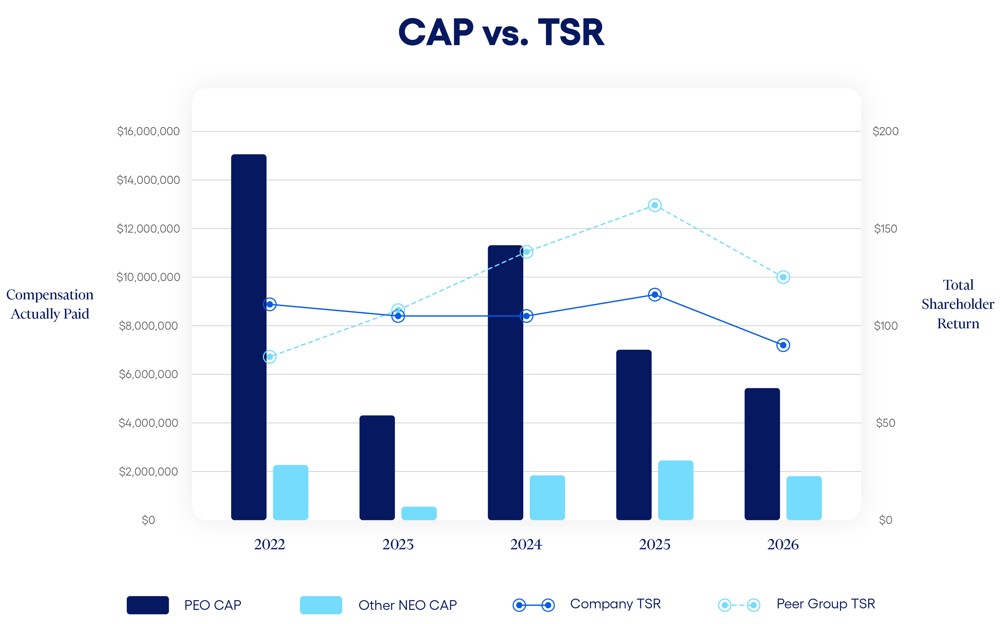
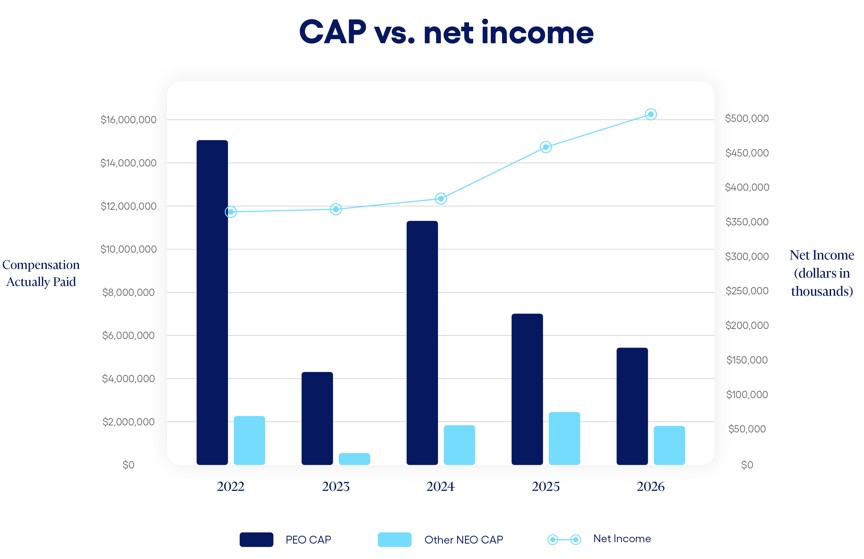
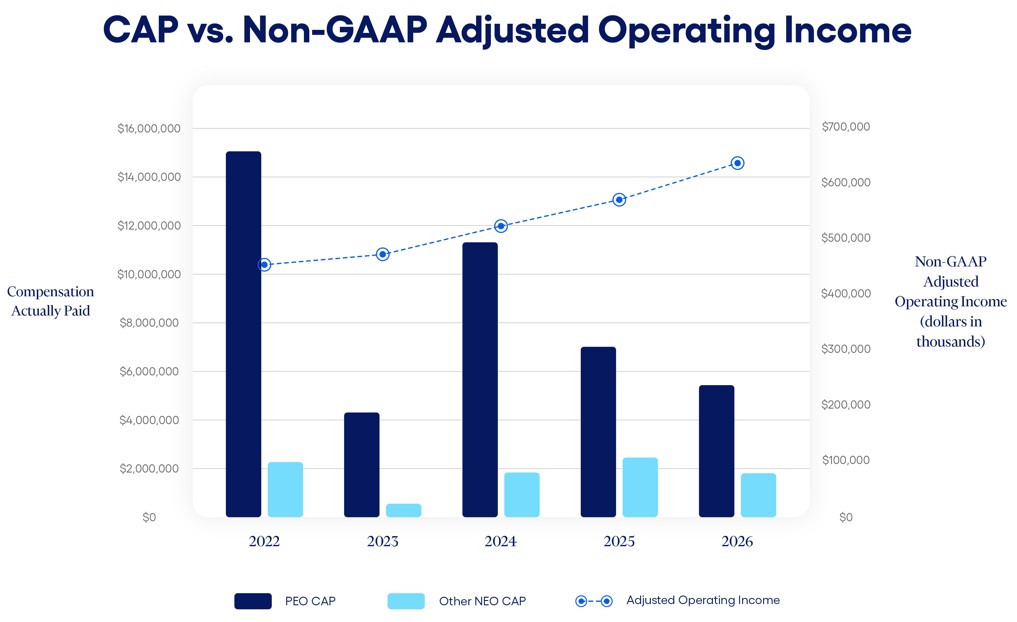
60 | 2026 Proxy Statement | | |||||||||
PROPOSAL 2
ADVISORY VOTE ON EXECUTIVE COMPENSATION
| The Board recommends that you vote “For” the approval of the compensation of our Named Executives | ||||
As required by Section 14A of the Securities Exchange Act, we include in this proxy statement this proposal for a non-binding stockholder vote on compensation of our Named Executives. We currently conduct annual advisory votes on executive compensation. With this year’s “say on pay” proposal you can elect to endorse or not endorse our executive compensation programs and policies and the compensation we paid our Named Executives in fiscal 2026.
Approval of the non-binding stockholder vote on compensation of our Named Executives requires the affirmative vote of a majority of the votes cast for and against the proposal. Abstentions will have no effect for purposes of determining the vote.
The say on pay vote is advisory and not binding on the Company, the Human Capital & Compensation Committee, or the Board. However, the Human Capital & Compensation Committee and the Board value the opinions of our stockholders and will consider the outcome of the vote when making future decisions regarding executive compensation.
As described in the Compensation Discussion and Analysis, the Human Capital & Compensation Committee has designed the executive compensation program to focus the executives on achieving consistent earnings growth, encourage continuation of the Company’s entrepreneurial spirit, attract and retain highly qualified and motivated executives, reward the creation of stockholder value, encourage esprit de corps, and reward outstanding performance. In designing the overall executive compensation program, the Company’s Human Capital & Compensation Committee strives for the interests of management and stockholders to be the same—the maximization of stockholder value.
Our executive compensation package for our Named Executives includes both cash and equity-based compensation, with an emphasis on at-risk and performance-based pay. The Human Capital & Compensation Committee each year reviews and updates our executive compensation program to ensure it achieves the desired goals.
The Board believes that the compensation of the Named Executives is appropriate and effective in achieving the Company’s objectives. Accordingly, the Board recommends that you vote to approve, on an advisory basis, the following resolution:
“RESOLVED, that the compensation paid to the Named Executives, as disclosed in the Company’s Proxy Statement for the 2026 Annual Meeting of Stockholders pursuant to the compensation disclosure rules of the Securities and Exchange Commission, including the Compensation Discussion and Analysis, the compensation tables and related narrative disclosure, is hereby approved.”
THE BOARD RECOMMENDS THAT YOU VOTE “FOR” THE APPROVAL OF THE COMPENSATION OF OUR NAMED EXECUTIVES. PROXIES RECEIVED BY THE BOARD WILL BE VOTED FOR THE APPROVAL OF THE COMPENSATION OF OUR NAMED EXECUTIVES UNLESS STOCKHOLDERS SPECIFY IN THEIR PROXY A VOTE OF “AGAINST” OR “ABSTAIN.” | ||||||||||||||
| 2026 Proxy Statement | 61 | |||||||||
PROPOSAL 3
RATIFICATION OF SELECTION OF
INDEPENDENT REGISTERED PUBLIC ACCOUNTING FIRM
| The Board recommends that you vote “For” ratification of the selection of PricewaterhouseCoopers, LLP as our independent registered accounting firm | ||||
PricewaterhouseCoopers LLP, an independent registered public accounting firm, performed an audit of our consolidated financial statements for the fiscal year ended June 30, 2026 and the effectiveness of our internal control over financial reporting as of June 30, 2026. The Audit Committee has selected PricewaterhouseCoopers LLP to serve as our independent registered public accounting firm for the current fiscal year, and the Audit Committee is presenting this selection to stockholders for ratification. Representatives of PricewaterhouseCoopers, LLP are expected to be present at the Annual Meeting with the opportunity to make a statement if they desire to do so and to be available to respond to appropriate questions.
If prior to the Annual Meeting PricewaterhouseCoopers, LLP declines to act as our independent registered public accountant or the Audit Committee decides not to use PricewaterhouseCoopers LLP as our independent registered public accountant, the Audit Committee will appoint another independent registered public accounting firm. The Audit Committee will present any new independent registered public accounting firm for the stockholders to ratify at the Annual Meeting. If the stockholders do not ratify the engagement of PricewaterhouseCoopers LLP at the Annual Meeting, then the Audit Committee will reconsider its selection of PricewaterhouseCoopers LLP. Even if the appointment of PricewaterhouseCoopers LLP is ratified, the Audit Committee in its discretion may direct the appointment of a different independent auditor at any time during the year if it determines that such a change would be in the best interests of the Company and our stockholders.
To ratify the selection of PricewaterhouseCoopers LLP as our independent registered public accounting firm for the fiscal year ending June 30, 2027, a majority of the votes cast for and against the proposal must vote to approve. Abstentions will have no effect for purposes of determining the vote.
Audit and Non-Audit Fees
The following table presents fees for professional audit services rendered by PricewaterhouseCoopers LLP for the audit of the Company’s annual consolidated financial statements for the fiscal years ended June 30, 2026 and 2025, and reviews of the financial statements included in the Company’s Forms 10-Q for those fiscal years, the audit of the Company’s assessment and effectiveness of internal control over financial reporting under Section 404 of the Sarbanes-Oxley Act of 2002, and fees for other services rendered during those periods.
62 | 2026 Proxy Statement | | |||||||||
| 2026 | 2025 | |||||||
| Audit Fees | 2,366,609 | 2,283,000 | ||||||
| Audit-Related Fees (1) | 3,147,919 | 3,277,491 | ||||||
| Tax Fees (2) | 27,500 | 27,500 | ||||||
| All Other Fees | 2,000 | 2,000 | ||||||
| Total Fees | $5,544,028 | $5,589,991 | ||||||
(1)Performed in accordance with system and organization controls reports (SOC 1 and SOC 2) and the review of other SEC filings. SOC 1 and SOC 2 reviews are conducted to evaluate the effectiveness of operational controls in various regulated business operations of the Company, including our data processing service bureaus.
(2)Tax fees for fiscal 2026 and fiscal 2025 relate to U.S. federal, state and local tax planning and compliance.
In making its decision to continue to retain PricewaterhouseCoopers LLP as the Company’s independent registered public accounting firm for the next fiscal year, the Audit Committee has considered the above information to ensure that the provision of non-audit services will not negatively impact the maintenance of the firm’s independence.
The Audit Committee has in its Charter expressed its policy governing the engagement of the Company’s independent registered public accounting firm for audit and non-audit services. Under the terms of the Charter, the Audit Committee is required to pre-approve all audit, audit-related, and non-audit services performed by the Company’s independent registered public accounting firm. All non-audit services for fiscal 2026 were pre-approved by the Audit Committee.
At the beginning of each fiscal year, the Audit Committee reviews with management and the independent registered public accounting firm the types of services that are likely to be required throughout the year. Those services are comprised of four categories: audit services, audit-related services, tax services, and all other permissible services. The independent registered public accounting firm provides documentation for each proposed specific service to be provided. At that time, the Audit Committee pre-approves a list of specific services that may be provided within each of these categories and sets fee limits for each specific service or project. Management is then authorized to engage the independent registered public accounting firm to perform the pre-approved services as needed throughout the year, subject to providing the Audit Committee with regular updates. The Audit Committee reviews all billings submitted by the independent registered public accounting firm on a regular basis to ensure that their services do not exceed pre-defined limits. The Audit Committee or its Chair reviews and approves in advance, on a case-by-case basis, all other projects, services and fees to be performed by or paid to the independent registered public accounting firm. The Audit Committee also approves in advance any fees for pre-approved services that exceed the pre-established limits, as described above.
THE BOARD RECOMMENDS THAT YOU VOTE “FOR” RATIFICATION OF THE SELECTION OF PRICEWATERHOUSECOOPERS LLP AS OUR INDEPENDENT REGISTERED ACCOUNTING FIRM. PROXIES RECEIVED BY THE BOARD WILL BE VOTED FOR THE RATIFICATION UNLESS STOCKHOLDERS SPECIFY IN THEIR PROXY A VOTE OF “AGAINST” OR “ABSTAIN.” | ||||||||||||||
| 2026 Proxy Statement | 63 | |||||||||
STOCK OWNERSHIP OF CERTAIN BENEFICIAL OWNERS
The following table sets forth information concerning the beneficial ownership of shares of the Company’s common stock of (a) those individuals who are known to be the beneficial owners, as defined in Rule 13d-3 of the Exchange Act, of 5% or more of the Company’s common stock, (b) each director and director nominee, (c) the executive officers named in the Summary Compensation Table and (d) all of our current directors and executive officers as a group. The mailing address of each director, director nominee, and executive officer shown in the table below is c/o Jack Henry & Associates, Inc., 663 Highway 60, Monett, Missouri 65708.
Beneficial Owner | Number of Shares Beneficially Owned (1) | Percentage of Shares Outstanding (1) | |||||||||||||||
| Kayne Anderson Rudnick Investment Management, LLC | 5,862,055 | (2) | 8.4% | ||||||||||||||
| Vanguard Capital Management | 5,393,818 | (3) | 7.7% | ||||||||||||||
| BlackRock Inc. | 4,796,533 | (4) | 6.8% | ||||||||||||||
| State Street Corporation | 3,976,907 | (5) | 5.7% | ||||||||||||||
| Vanguard Portfolio Management | 3,567,507 | (6) | 5.1% | ||||||||||||||
| Wesley A. Brown | 94,969 | (7) | * | ||||||||||||||
| Matthew C. Flanigan | 45,674 | (7) | * | ||||||||||||||
| Thomas A. Wimsett | 41,095 | (7) | * | ||||||||||||||
| Thomas H. Wilson, Jr. | 17,872 | (7)(8) | * | ||||||||||||||
| Gregory R. Adelson | 30,128 | (9) | * | ||||||||||||||
| Shruti S. Miyashiro | 15,896 | (7) | * | ||||||||||||||
| Renee A. Swearingen | 14,835 | * | |||||||||||||||
| Craig K. Morgan | 11,862 | (10)(11) | * | ||||||||||||||
| Mimi L. Carsley | 7,819 | (12) | * | ||||||||||||||
| Curtis A. Campbell | 2,689 | (7)(13) | * | ||||||||||||||
| Shanon G. McLachlan | 3,068 | (14) | * | ||||||||||||||
| Tammy S. LoCascio | 2,744 | (7) | * | ||||||||||||||
| Lisa M. Nelson | 2,744 | (7) | * | ||||||||||||||
| Richard N. Preece | 270 | (15) | * | ||||||||||||||
| All current directors and executive officers as a group (14 persons) | 291,665 | * | |||||||||||||||
| * Less than 1% | |||||||||||||||||
(1)Except as otherwise noted in the footnotes, information is set forth as of September 21, 2026. The persons named in the table have sole voting and investment power with respect to all shares of common stock shown as beneficially owned by them, except as noted below. With respect to shares held in the Company’s Retirement Plan, a participant has the right to direct the disposition of shares allocated to their account and a participant is allowed to vote the shares held in their individual account. Calculation of percentage of beneficial ownership includes the assumed exercise of options to purchase common stock by only the respective named stockholder that are vested or that will vest within 60 days of September 21, 2026 and any restricted stock units owned by such person that will vest within 60 days of September 21, 2026.
(2)According to a Schedule 13G filed February 13, 2026, Kayne Anderson Rudnick Investment Management, LLC has shared voting power with respect to 1,212,079 shares, sole voting power with respect to 4,136,820 shares, shared dispositive power with regards to 1,212,079 shares, and sole dispositive power with respect to 4,649,976 shares. The address for Kayne Anderson Rudnick Investment Management, LLC is 2000 Avenue of the Stars, Suite 1110, Los Angeles, CA 90067.
64 | 2026 Proxy Statement | | |||||||||
(3)According to a Schedule 13G filed April 30, 2026, Vanguard Capital Management has shared dispositive power with respect to 0 shares, sole dispositive power with respect to 5,393,818 shares, shared voting power with respect to 0 shares, and sole voting power with respect to 713,408 shares. The address for Vanguard Capital Management is 100 Vanguard Blvd., Malvern, PA 19355.
(4)According to a Schedule 13G filed July 28, 2026, BlackRock Inc. has sole voting power with respect to 4,524,494 shares and sole dispositive power with respect to 4,769,533 shares. The address for BlackRock Inc. is 50 Hudson Yards, New York, NY 10001.
(5)According to a Schedule 13G filed October 14, 2024, State Street Corporation has shared voting power with respect to 2,631,367 shares and shared dispositive power with regards to 3,976,658 shares. The address for State Street Corporation is One Congress Street, Suite 1, Boston MA 02114.
(6)According to a Schedule 13G filed July 31, 2026, Vanguard Portfolio Management has shared dispositive power with respect to 0 shares, sole dispositive power with respect to 3,567,507 shares, shared voting power with respect to 0 shares, and sole voting power with respect to 8,106 shares. The address for Vanguard Portfolio Management is 100 Vanguard Blvd., Malvern, PA 19355.
(7)Includes 1,220 restricted stock units for Mses. Miyashiro, LoCascio, and Nelson, and Messrs. Flanigan, Wilson, Wimsett, Brown, and Campbell, that will vest on the earlier of (i) the day before the Company’s Annual Meeting or (ii) November 17, 2026.
(8)Mr. Wilson has elected to defer receipt of 9,982 restricted stock units, which have fully vested and will become payable, in cash or common stock at the Company’s option, upon Mr. Wilson’s termination of service as a director of the Company or on specified future dates pursuant to Mr. Wilson’s deferral elections. Each restricted stock unit is the economic equivalent of one share of common stock. These deferred restricted stock units have been excluded from the amounts set forth in this table.
(9)Mr. Adelson has elected to defer receipt of 3,561 performance shares, which have fully vested and will become payable, in cash or common stock, at the Company’s option, upon Mr. Adelson’s termination of service with the Company or on specified future dates pursuant to Mr. Adelson’s deferral elections. Each performance share is the economic equivalent of one share of common stock. These deferred performance shares have been excluded from the amounts set forth in this table.
(10)Includes 1,226 shares held in the Retirement Plan for Mr. Morgan’s account.
(11)Mr. Morgan has elected to defer receipt of 1,614 restricted stock units, which have fully vested and will become payable, in cash or common stock at the Company’s option, upon Mr. Morgan's termination of service with the Company or on specified future dates pursuant to Mr. Morgan's deferral elections. Each restricted stock unit is the economic equivalent of one share of common stock. These deferred restricted stock units have been excluded from the amounts set forth in this table.
(12)Mrs. Carsley has elected to defer receipt of 8,720 restricted stock units, which have fully vested and will become payable, in cash or common stock at the Company’s option, upon Mrs. Carsley's termination of service with the Company or on specified future dates pursuant to Mrs. Carsley's deferral elections. Each restricted stock unit is the economic equivalent of one share of common stock. These deferred restricted stock units have been excluded from the amounts set forth in this table.
(13)Mr. Campbell has elected to defer receipt of 3,315 restricted stock units, which have fully vested and will become payable, in cash or common stock at the Company’s option, upon Mr. Campbell’s termination of service as a director of the Company or on specified future dates pursuant to Mr. Campbell's deferral elections. Each restricted stock unit is the economic equivalent of one share of common stock. These deferred restricted stock units have been excluded from the amounts set forth in this table.
(14)Mr. McLachlan has elected to defer receipt of 716 performance shares, which have fully vested and will become payable, in cash or common stock at the Company’s option, upon Mr. McLachlan’s termination of service with the Company or on specified future dates pursuant to Mr. McLachlan's deferral elections. Each restricted stock unit is the economic equivalent of one share of common stock. These deferred restricted stock units have been excluded from the amounts set forth in this table.
(15)Includes 270 restricted stock units for Mr. Preece that will vest on the day before the Company’s Annual Meeting.
| 2026 Proxy Statement | 65 | |||||||||
STOCKHOLDER PROPOSALS AND NOMINATIONS
Stockholders who intend to present proposals for inclusion in the proxy statement and form of proxy for the 2027 Annual Meeting of Stockholders must submit their proposals to the Company’s Secretary on or before June 4, 2027. A stockholder who wishes to present a proposal at the 2027 Annual Meeting, but who does not request inclusion in the proxy statement, must submit the proposal to the Company’s Secretary by August 21, 2027. The Company’s Bylaws specify requirements for the content of the notice that stockholders must provide.
In addition, any stockholder who intends to nominate a candidate for election to the Board at the Company’s 2027 Annual Meeting pursuant to the advance notice provisions of the Bylaws, must give notice to the Company’s Secretary on or before August 21, 2027. Notice of proxy access director nominees by stockholders who meet the eligibility requirements in the Company’s Bylaws must be received by the Company’s Secretary no earlier than the close of business on May 5, 2027 and no later than the close of business on June 4, 2027. In each case, the notice must include information specified in the Company’s Bylaws, including information concerning the nominee and information about the stockholder’s ownership of, and agreements related to, the Company’s common stock.
In addition to satisfying the foregoing advance notice requirements under our Bylaws, to comply with the universal proxy rules under the Exchange Act, stockholders who intend to solicit proxies in support of director nominees other than our nominees must provide notice that sets forth the information required by Rule 14a-19 under the Exchange Act no later than September 21, 2027.
The Company will not entertain any proposals or nominations at the 2027 Annual Meeting that do not meet the requirements set forth in the Company’s Bylaws. If the stockholder does not also comply with the requirements of Rule 14a-4(c)(2) under the Exchange Act, as amended, the Company may exercise discretionary voting authority under proxies that it solicits to vote in accordance with the Company’s best judgment on any such stockholder proposal or nomination. The Bylaws are posted on our web site at https://ir.jackhenry.com/corporate-governance/overview. To make a submission or to request a copy of our Bylaws, stockholders should contact the Company’s Secretary. We strongly encourage stockholders to seek advice from knowledgeable counsel before submitting a proposal or a nomination.
FINANCIAL STATEMENTS
Consolidated financial statements of the Company are contained in the 2026 Annual Report to Stockholders which accompanies this Proxy Statement.
66 | 2026 Proxy Statement | | |||||||||
FREQUENTLY ASKED QUESTIONS REGARDING THE ANNUAL MEETING
Why am I receiving these materials?
You have received these materials because the Board is soliciting your proxy to vote your shares at the Annual Meeting. This Proxy Statement includes information that the Company is required to provide you under the SEC rules and is designed to assist you in voting your shares.
What matters will be voted on at the Annual Meeting?
At the Annual Meeting, stockholders will consider and vote upon the following matters:
| Proposal | Board Recommendation | Page | ||||||
(1) The election of nine directors to serve until the 2027 Annual Meeting of Stockholders | FOR each nominee | |||||||
| (2) Approval, on an advisory basis, of the compensation of our named executive officers | FOR | |||||||
(3) To ratify the selection of PricewaterhouseCoopers LLP as the Company’s independent registered public accounting firm for the fiscal year ending June 30, 2027 | FOR | |||||||
In addition, the stockholders will consider and vote upon such other business as may properly come before the Annual Meeting and any adjournments thereof.
When and Where is the Annual Meeting?
The Annual Meeting will be held at the Company’s Headquarters, 663 Highway 60, Monett, Missouri, on Thursday, November 19, 2026, 11:00 a.m., Central Time. The Annual Meeting will be in the Company’s Executive Conference Center in the lower level (Building J-7).
Who can attend and vote at the Annual Meeting?
Only stockholders of record at the close of business on September 21, 2026, the record date set by the Board for the Annual Meeting, are entitled to notice of and to vote at such meeting. A list of these stockholders will be available during the ten days prior to the meeting at the Company’s headquarters at 663 Highway 60, Monett, Missouri.
The Company’s authorized capital stock currently consists of 250,000,000 shares of common stock, par value $.01 per share, and 500,000 shares of preferred stock, par value $1.00 per share. As of September 21, 2026, there were 70,111,999 shares of common stock outstanding and no shares of preferred stock outstanding. At such date, our executive officers and directors were entitled to vote, or to direct the voting of, shares of Common Stock representing less than 1% of the shares entitled to vote at the Annual Meeting. Each share of our common stock outstanding on the record date will be entitled to one vote on each matter.
How will the Annual Meeting be conducted?
Stockholders and guests may attend the Annual Meeting in person. The Company will hold a question and answer session with management immediately following the conclusion of the business to be conducted at the Annual Meeting. To help ensure that the Annual Meeting is productive and efficient, and in fairness to all stockholders in attendance, the Company requests that meeting participants limit participation to one question or comment and that remarks are respectful of fellow stockholders and meeting participants. Questions may be ruled as out of order if they are, among other things: irrelevant to our business; related to legal matters, ongoing negotiations or potential transactions, or other matters upon which the Company does not comment on; disorderly; repetitious of statements already made; or in furtherance of the speaker’s own personal, political, or business interests. The Company reserves the right to eject participants or cut off speaking privileges for failure to comply with reasonable requests or the rules of conduct for the meeting.
| 2026 Proxy Statement | 67 | |||||||||
How can I vote?
Stockholders may submit their votes in the following ways:
1.At the Annual Meeting. Stockholders of record may vote in person at the Annual Meeting; or
2.By Proxy. There are three ways to vote by proxy:
•by internet, following the instructions on the enclosed Proxy Card;
•by mail, using the enclosed Proxy Card and return envelope; or
•by telephone, using the number and instructions on the enclosed Proxy Card.
Even if a stockholder expects to attend the Annual Meeting, it is advisable to vote by proxy to ensure such stockholder’s vote is represented.
What is the voting requirement to approve the proposals?
In an uncontested election, a director nominee must be elected by a majority of the votes cast, in person or by proxy, regarding the election of that director nominee. A “majority of the votes cast” for the purposes of director elections means that the number of votes cast “For” a director nominee’s election exceeds the number of votes cast as “Against” that director nominee. If an incumbent director is not re-elected in an uncontested election and no successor is elected at the same meeting, the Company’s Corporate Governance Guidelines require that such director must offer to tender his or her resignation to the Board.
In a contested election, which occurs when the number of director nominees exceeds the number of open seats on the Board, director nominees will be elected by a plurality of the shares represented in person or by proxy at the meeting. A “plurality” means that the open seats on the Board will be filled by those director nominees who received the most affirmative votes, regardless of whether those director nominees received a majority of the votes cast with respect to their election.
At the Annual Meeting, the election of directors is considered to be uncontested because we have not been notified of any other nominees as required by our Bylaws. To be elected, each director nominee must receive a majority of votes cast regarding that nominee.
The approval of all the other matters to be voted on at the Annual Meeting will require the affirmative vote of a majority of the votes cast, in person or by proxy, for and against the proposal.
Abstentions and shares held by brokers that do not have discretionary authority to vote on a particular matter and that have not received voting instructions from their clients (broker non-votes) will have no effect on the election of directors or on determining whether the stockholders have approved other matters, but they are counted as present for the purpose of determining the existence of a quorum at the Annual Meeting. Please note that banks and brokers that have not received voting instructions from their clients cannot vote on their clients’ behalf on “non-routine” proposals. The election of directors (Proposal 1) and the advisory votes on the compensation of our named executive officers (Proposal 2) are considered to be “non-routine” proposals.
How are Proxy Materials being distributed?
We are furnishing proxy materials to our stockholders primarily via “Notice and Access” delivery. On or about October 2, 2026, we mailed to our stockholders (other than those who previously requested email or paper delivery) a Notice of Internet Availability containing instructions on how to access the proxy materials via the Internet. If you receive the Notice of Internet Availability by mail, you will not receive a printed copy of the proxy materials in the mail. Instead, the Notice of Internet Availability instructs you on how to access the proxy materials and vote by going to a secure website.
If you received the Notice of Internet Availability by mail and would like to receive paper copies of the proxy materials in the mail on a one-time or ongoing basis, follow the instructions in the Notice of Internet Availability for making this request. If you would like to receive an electronic copy of the proxy materials by email on a one-time or ongoing basis, follow the instructions in the Notice of Internet Availability for making this request.
68 | 2026 Proxy Statement | | |||||||||
What if I share a household with another Company Stockholder?
If you and other residents at your mailing address own shares in street name, your broker, bank, or other nominee may have sent you a notice that your household will receive only one annual report and proxy statement for each company in which you hold shares through that broker, bank, or nominee. This practice is called “householding.” If you did not respond that you did not want to participate in householding, you are deemed to have consented to that process. If these procedures apply to you, your broker, bank, or other nominee will have sent one copy of our 2026 Annual Report to Stockholders and Proxy Statement to your address. You may revoke your consent to householding at any time by contacting your broker, bank, or other nominee. If you did not receive an individual copy of our 2026 Annual Report to Stockholders and Proxy Statement, we will send copies to you if you contact us at 663 Highway 60, Post Office Box 807, Monett, Missouri, 65708, (417) 235-6652, Attention: Investor Relations. If you and other residents at your address have been receiving multiple copies of our 2026 Annual Report to Stockholders and Proxy Statement and desire to receive only a single copy of these materials, you may contact your broker, bank, or other nominee or contact us at the above address or telephone number.
Who will pay for this solicitation?
Proxy solicitation is being made by mail, although it may also be made by telephone or in person by officers, directors, and employees of the Company not specifically engaged or compensated for that purpose. The Company will bear the entire cost of the Annual Meeting, including the cost of preparing, assembling, printing, and mailing this Proxy Statement, the Proxy Card, Notice of Internet Availability, and any additional materials furnished to stockholders. Copies of the solicitation materials will be furnished to brokerage houses, fiduciaries, and custodians for forwarding to the beneficial owners of shares held of record by them and, upon their request, such persons will be reimbursed for their reasonable expenses incurred in completing the mailing to such beneficial owners.
What happens if I vote by proxy and do not give specific voting instructions?
If a stockholder does not specify how a proxy is to be voted, the shares represented thereby will be voted: (1) FOR the election as directors of the nine persons nominated by the Board; (2) FOR approval of the compensation of our named executive officers; (3) FOR ratification of the selection of the Company’s independent registered public accounting firm; and (4) upon other matters that may properly come before the Annual Meeting, in accordance with the discretion of the persons to whom the proxy is granted.
Can I revoke my proxy or change my vote?
Any stockholder executing a Proxy Card retains the power to revoke it at any time prior to the voting of the proxy. It may be revoked by a stockholder personally appearing at the Annual Meeting and casting a contrary vote, by filing an instrument of revocation with the Secretary of the Company, or by the presentation at the Annual Meeting of a duly executed later-dated Proxy Card.
What happens if additional matters are presented at the Annual Meeting?
The Board knows of no matters that are expected to be presented for consideration at the Annual Meeting which are not described herein. The Company will not entertain any proposals or nominations at the Annual Meeting that do not meet the advance notice requirements set forth in the Company’s Bylaws. However, if other matters properly come before the meeting, it is intended that the persons named in the accompanying Proxy Card will vote thereon in accordance with their best judgment.
How can I vote if I am the beneficial owner and my shares are held by a broker, trustee, or other nominee?
If a stockholder’s shares are held in the name of a bank, broker, or other nominee, that nominee will provide separate instructions on how to vote. Those stockholders may vote at the Annual Meeting if they obtain and bring to the Annual Meeting a legal proxy from the bank, broker, or other nominee holding the shares.
If you are a participant in the Company’s Retirement Plan and you own shares of our common stock through the Retirement Plan, you may vote by proxy or you may receive separate instructions on how to direct the Retirement Plan trustee how to vote those shares on your behalf. If you do not vote by proxy or otherwise provide voting instructions for these shares, then, as permitted by the terms of the Retirement Plan, the Retirement Plan administrator will instruct the trustee to vote your Retirement Plan shares (1) FOR the election as directors of the nine persons nominated by the Board; (2) FOR approval of the compensation of our
| 2026 Proxy Statement | 69 | |||||||||
named executive officers; (3) FOR ratification of the selection of the Company's independent registered public accounting firm; and (4) upon other matters that may properly come before the Annual Meeting, in accordance with the discretion of the persons to whom the proxy is granted.
Other Information
Important Notice Regarding the Availability of Proxy Materials for the Stockholder Meeting to be Held on November 19, 2026: The Proxy Statement, Proxy Card, and the 2026 Annual Report to Stockholders are available at www.envisionreports.com/JKHY.
70 | 2026 Proxy Statement | | |||||||||